Now that I’ve finished writing my blog series on visiting Armenia again, twenty-six years after I finished my Peace Corps service there, it’s time for my obligatory “ten things I learned” post. I like creating these posts because they make me think, and because they’re a lot of fun to write. Also, readers seem to like them, because they’re comprehensive, yet concise. Or, they are as concise as I tend to be, anyway. Brevity is not one of my strong suits.
Armenia has changed a lot since 1997. Even though I spent 27 months there, I still learned new things during our trip. So here goes with ten things I learned in Armenia!
Lights! Unheard of and unseen in the 90s!
10. Yerevan is now a city that doesn’t sleep!
When I lived in Yerevan, things didn’t necessarily stay open all night. There was an energy crisis. Even though it technically ended in 1995, not everyone had 24 hour power until about 1996. So, even though flights would leave and arrive in the wee hours of the mornings, things did close at night. Now, I notice that restaurants and bars stay open very late. You can buy a SIM card 24 hours a day. And there are always lights on at night. That wasn’t how it was when I lived there.
Two different versions of 1000 dram notes…
9. The drams have changed twice since I left!
Armenian drams were introduced in 1993, just after the fall of the Soviet Union. Since I arrived in 1995, I was used to the first version of Armenian drams. Now, the drams have changed their look and denominations twice since I left in 1997. When I left, the biggest bill was 5000 drams (about $12). Now, they go up to 100,000 drams!
Need a ride to Garni and Geghard? You can find one easily!
8. It’s easy to find someone to drive you to Armenia’s most famous sites.
We didn’t take any of the many aspiring drivers up on their offers to take us to Armenia’s most amazing sites, but if we’d wanted to hire a driver, it would have been easy. Our hotel offered drivers for hire, and there were many of them hanging around different parts of the city. It’s no longer necessary to go to the bus station and look for a taxi, minivan, or bus to take you to Sevan or Khor Virap. Most of them have signs in English, too.
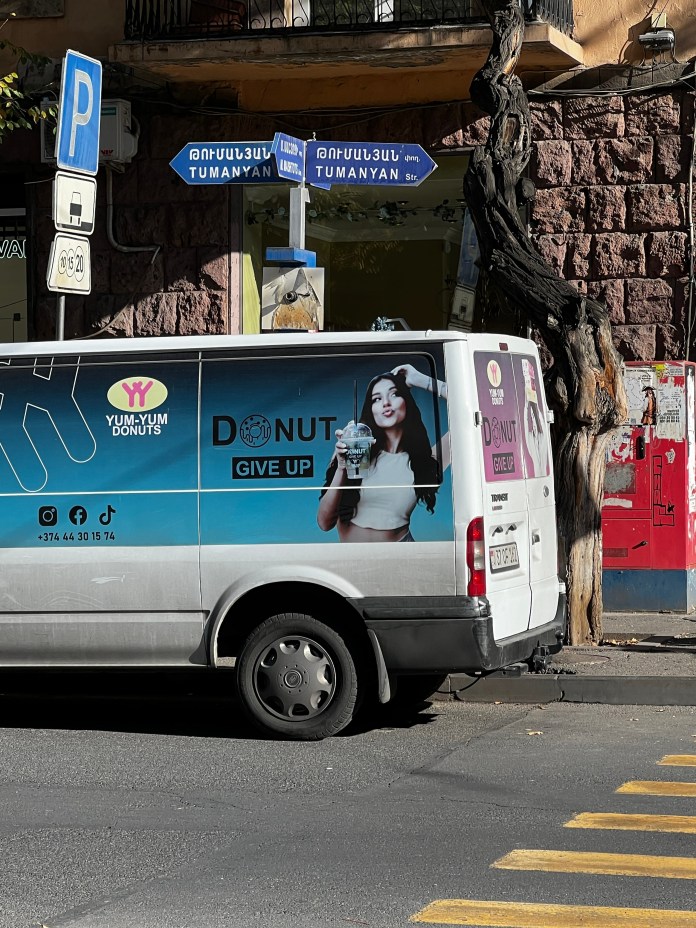
7. Speaking of English, it’s EVERYWHERE in Yerevan, now.
I saw so many signs in English. Some of them were hilariously incorrect, but just as many were hilariously witty. Obviously, there’s a movement for people to learn English, just as so many older folks had to learn Russian. I’m sure English is not required as Russian once was, but a lot of people seem to want to learn.
Cheers!
6. Armenia now has some really decent craft beers!
When I lived in Armenia, I used to joke about how bad the beers were from there. I had particularly salty things to say about Kotayk Beer, which when it was made in Armenia, was notoriously rough on the digestive system. Thanks to Dargett, a local craft beer company, you can find some good suds in Yerevan now. Now I wish I could get Dargett in GERMANY, a country well known for its excellent beers. That’s how good it was. You can also find real German beer in Armenia now. And not just the stuff made by InBev, which is a Belgian company that distributes a lot of mass produced beers. Naturally, if wine or fruit juice or even mineral water is your thing, you can find plenty of that, too. And wonderful brandy– the best I’ve ever had anywhere!
5. You can also get a beautiful meal in Yerevan…
When I first arrived in Armenia, there weren’t many restaurants at all. A few popped up while I was a Peace Corps Volunteer, but they tended to have plastic chairs and tables, and served pretty basic stuff. Now, you can get gourmet food in Yerevan… They have fine dining restaurants! And even if you go to a casual place, chances are good what you eat will look beautiful. That was one thing that didn’t change. There’s much more variety now, and some items are better quality, or are just plain available. In the 90s, we tended to eat what we could get, which meant whatever was in season. That no longer seems necessary.
Don’t be afraid to venture inside!
4. Public toilets in Yerevan are now very clean and cost 100 drams to use.
I remember many times having to duck behind bushes to relieve myself, when I lived in Yerevan in the 90s. One time, when I was out with my former language teacher, we went to a porno theater so I could pee. It was actually very clean. But most public facilities in the 90s were pretty disgusting and smelled horrible. I was very pleased to find clean restrooms in most places during our recent visit. The toilet by the Opera House was sparkling clean, well stocked, and cost 100 drams (about 25 cents). Cheap!
No longer a traditional shuka… but at least it has parking.
3. Some historic places have changed forever…
I was sad to see that the historic landmark, the Pak Shuka on Mashtots Avenue, has become a regular supermarket. I would have liked to have taken Bill in there. Ditto for what used to be the GUM, a department store on Abovian Street, and the Hayastan Market (which had changed as I was leaving). But some things are better now. For instance, the eternal flame at Tsitsernakaberd now is a true eternal flame. They leave it burning all the time, instead of just on special occasions. And the door to the Blue Mosque is now very well marked, so you can’t miss it. When I lived in Yerevan, the door to the mosque was very plain, and easy to miss. Northern Avenue is a really nice street that makes it convenient to be a pedestrian, although who knows what happened to the people who lived in the houses that were destroyed so it could be built?
Maybe we can go back and try visiting the Hrazdan Gorge again.
2. Yerevan is very safe, but that doesn’t mean there aren’t creepers there.
We ran into one of them on our wedding anniversary. He was up to no good, and not very subtle about it. However, he was acting this way in broad daylight, which was strange. I don’t know what he was up to, but I didn’t get a good feeling about it. We ended up going a different way than we planned, which worked out fine, and that was the only strange incident. It was a good reminder to always be aware and keep your wits about you. That’s good advice no matter where you go.
I bet this guy is a lot of fun to talk to… He certainly was a good singer!
And finally, 1. Although Yerevan is now a lot more modern than it used to be, and more travel friendly, it’s still very exotic and will be quite interesting to most people… and if you can speak a few words of Armenian, it will open doors for you!
I was happy that some of my old, rusty language skills came back, and I was able to speak enough Armenian to be understood by a lot of the locals. Many of them were delighted when I spoke their language… and quite a few were shocked when it turned out I wasn’t Russian. I know they get more foreigners visiting now, but it’s still not a place that is super high on the tourism list for westerners. So I would absolutely encourage adventure seekers to come visit Armenia. I would especially encourage it now, because Armenians have so much to offer; they do need the tourism drams; and sadly, if a couple of neighboring countries have their way, Armenia might someday cease to exist. So please visit, if I’ve tempted you. You will be very warmly welcomed by most! And be sure to tip 10 percent!
I want to offer special thanks to Stepan, my former student and current friend. He made us feel like FAMILY… and was so kind, welcoming, and generous. Stepan, you made this trip unforgettable, and you showed us the warmth and hospitality that Armenia is known for. It was a vacation like no other, and I will always be so grateful for all you did to make it so. So շատ շնորհակալություն! I hope we can come back again… much sooner than 26 years from now!
After our first breakfast in the rooftop restaurant at Paris Hotel Yerevan, Bill and I decided to take our first walk around Republic Square. Stepan had already contacted me to let me know that he and his daughter wanted to take us to Garni and Geghard, and then out for khorovatz (Armenian BBQ). I was excited about the prospect of visiting Garni and Geghard, as they are places that anyone who comes to Armenia should see. In fact, I believe they were the first places my group visited when we arrived in 1995. I was also VERY excited about the prospect of having Armenian BBQ, because it is delicious, and not that easy to find if you’re not in the country.
As we strolled around Republic Square (Հանրապետության հրապարակ, Hanrapetut′yan hraparak), which is considered the center of Yerevan, I pointed out to Bill places of interest. There was Hotel Armenia/the Marriott, which takes up one corner of the square. On the side of the building is a bank, that was once Midland Bank out of the United Kingdom. I remember that was where the very first ATM machine in the country was installed. Midland Bank is now long gone, but there’s still an ATM there. Bill made use of it and got his first Armenian drams.
Even the money has changed since my days as a Peace Corps Volunteer. Back then, drams looked a little like Monopoly money. I remember hearing horror stories about how in late November 1993, when the dram became Armenia’s legal tender, Peace Corps Volunteers were receiving it as their pay, along with dollars that were supposed to be for “vacation”. The A 1s said that no one wanted to accept the drams. The locals wanted dollars or roubles. Consequently, many of the ones in that very scrappy first Peace Corps/Armenia group had trouble buying what they needed. In 1995, drams were accepted, but people still preferred getting paid in stronger currencies.
I remember paying my rent in US dollars, and having to pay the conversion fee… which I could ill afford. Today, drams are fine, and I didn’t notice anyone asking for euros or dollars in lieu of drams. In fact, while I did see some conversion offices, there weren’t nearly as many there last week as there were when I was a PCV. If you’d like to see how the drams have changed in appearance since the 90s, click here. As you can see, the look of the money has changed twice since the original drams came out in November 1993. I am most familiar with the 1993 version of Armenian drams.
Two different versions of 1000 dram notes. The purple one is the more recent version. Both kinds are circulating now.
Below is actual Armenian money that I brought home after I finished my Peace Corps service. I was pretty good at spending it all, back then. 600 Armenian drams equates to about $1.50. The coin is worth 10 drams, which in the 90s was useful for paying about 1/3 of a metro fare. It was 30 drams to ride the metro when I left in 1997– an increase from 20 drams when we arrived in 1995. Today, it costs 100 drams to ride the metro, which is still pretty damned CHEAP! That fare covers all ten stations, although you have to pay each time you ride. I did have to laugh when Bill asked me if there were “zones”. No… the Yerevan Metro only offers ten stations, but the metro covers a pretty good swath of the city.
When we were in Armenia last week, I noticed that both the second and third versions of drams are still circulating. They’re also using coins a lot more now. When I was living there, Armenian lumas (coins worth less than one dram) were basically worthless. But now, it looks like they’ve done away with lumas and now have coins worth between 10 and 500 drams. 500 drams used to be one of the highest denominations in dram bank notes! By the time I left in 1997, the 5000 dram notes were brand new. Now the notes go up to 100,000 drams.
As of today, one Armenian dram is equivalent to .0023 euro or .0025 US dollar. One dollar is equal to about 401 Armenian drams. When I lived in Armenia, one dollar bought between 400 and 500 drams. The values constantly fluctuated, and some conversion offices offered better rates than others.
After Bill got some new Armenian drams, we crossed the street. I pointed out where Lenin’s statue used to stand, overlooking the square. By the time of our 1995 arrival, Lenin’s statue had already been removed, but the base was still there. I believe I have a picture of it in my scrapbook, which is unfortunately in storage in Texas. I distinctly remember that there was a Soviet Union flag on the bottom of it. Not long after our arrival, the pedestal was removed. Today, there are beautiful flowers planted there. Stepan told me that Lenin’s statue is still being stored in the National Assembly building near Republic Square. I heard that in the 90s, too. It’s probably true. I would expect the Armenians to move Lenin to a museum at some point. I mean, that’s what I would do, if it were up to me. 😀 On the other hand, I’ve seen evidence that the statue has been beheaded.
You can see the Soviet flag at the bottom of the old Lenin statue on this postcard. I have a picture of that somewhere in storage. Lenin himself was gone by the time we arrived in 1995. Someone gifted me a pack of Soviet era postcards when I was a Volunteer. I had no concept of how priceless they would end up being to me.
This is a photo of Lenin’s statue being removed in the 1990s. The image was made available in Creative Commons. Special thanks to user Technetium for making this unaltered image free to use.
Next, I pointed out a post office where Volunteers were picking up their mail after we lost Diplomatic Pouch privileges. Back in the 90s, Armenian mail was so unreliable that the powers that be at the US Embassy in Yerevan let us PCVs use the Diplomatic Pouch to send and receive mail. That went on from the beginning of Peace Corps/Armenia’s existence, until a couple of months before I left. I remember my mom sent me a box and I picked it up at that post office… the postage cost more than the contents of the box! I also remember that people could order long distance phone calls at that post office, although I never had to do that. I had a credit card that I could use from my home phones, all of which were rotary dial models! Back then, it was easier to call the United States than certain places in Yerevan, like my school. But now, pretty much everyone has a cell phone or a computer, and now phone call problems “ch’ga” (ch’ga= there aren’t).
We continued walking around Republic Square. I pointed out the huge empty fountains near the National Gallery of Armenia. I told Bill about how, back in the hot summer days of my time in Armenia, it was common to see boys in their underwear, playing in the fountains. I never or very rarely saw girls in the fountains. It was always boys in their undergarments! They were completely unabashed, too. I always wondered how much pee was in the fountains whenever I saw kids playing in them! I don’t think we saw any fountains that were actually working last week. Even in the 90s, that was a rather occasional thing. Sometimes, they worked, and other times, they were kept empty.
I looked at my watch and realized we needed to get back to the hotel to meet Stepan. So we made our way back, and passed several old guys sitting on a bench on the corner of Amiryan Street. They were trying to get people to go on one of their day tours, and they had a lot of competition. A whole bunch of people with cars and vans were offering to take tourists to the biggest tourist attractions on Armenia. That was a change from the 90s, when a lot of drivers would hang out at the Aftogayan (bus station), or at certain other established places around the city. I was a little tempted to book a tour, but there were too many places in Yerevan that I wanted to see and show Bill. I knew we’d be walking, and it would take a lot of time. So we ignored the guys on the bench… and every time we passed them, one of the guys seemed to notice me and my platinum hair. He almost always made a sassy comment, which made me laugh.
We waited in the hotel lobby for Stepan, and I struck up a conversation with a very handsome clerk with striking green eyes. I had seen those eyes before in Armenia, but they always startle me. A lot of Armenians have black or dark brown hair and brown eyes. But some of them have this very unique, exotic look, and this hotel clerk was one of those lucky folks. I think his name was Koriuyn, and he spoke excellent English. He asked me why I knew any Armenian, and I explained that I had lived in Armenia and taught children English. I added, I was probably living there before he was born.
Koriuyn confirmed that. He said, “I was born in 2001.”
I laughed and said, “Then I was speaking Armenian before you were! You were a spark in your father’s eyes when I was living here.” And again, I had to comment on how much some things had changed.
Stepan then arrived with his lovely 17 year old daughter, Susi, whose English is impeccable and almost without a trace of an accent. Susi spent a year studying in an American high school. She was a lucky recipient of a FLEX scholarship (Future Leaders Exchange Program — AC Armenia), which is a program sponsored by the US government and offered in a number of developing countries. Susi lived in Washington State, and was hosted by Returned Peace Corps Armenia Volunteers. How lucky is that?
I got a big kick out of Susi, because the first thing she did was offer me a hug, after adding “Or are you not a hugger?” That is such an American thing to say! She was clearly excited to meet us, and was happy to trade stories with me, in particular, as we made our way to Geghard and Garni. As we drove out there, I was looking around the city, noticing again how developed it was, even though there are still many buildings in disrepair.
We even passed Yerevan’s waterpark, Water World, unthinkable in the 90s because of the energy crisis. I had read about the waterpark, but was still shocked it existed. It’s located right by a major highway, making it easy to spot. When we passed it, I said “That looks like a nightmare!” It appeared to be drained and maybe not very clean or safe. Susi said she hadn’t been there in a long time. Trip Advisor reviews confirm that it may be a bit of a “nightmare”.
We also passed what appeared to be a butcher shop. They had a pen that was packed with sheep, and as we drove by, I could see that there was a recently butchered sheep hanging there in plain view, thanks to an open door. The sight made me feel a little queasy and sad, although I understand that if you want to enjoy eating lamb or mutton, you have to kill one first.
I am definitely not a vegetarian myself, although I really admire people who don’t eat meat. Maybe this display is the better way to do things… and remind people that this is the stark reality behind eating meat. That wasn’t as shocking to me as the time I saw a pig’s head in a shop in Greece, and at least we were in car, so we passed quickly. I don’t eat lamb or mutton, so those poor sheep were safe from me. I should mention that some Armenians will buy a lamb to sacrifice at the church before a special occasion, such as a wedding. I remember seeing that the second time I visited.
Soon we arrived at Geghard, a cave monastery founded in the 4th century by Gregory the Illuminator, and Stepan bought an “Armenian Snickers”, which was really a chewy Churchkhela– a snack made with walnuts, grape must, and flour. Then we went into the church, where there was someone being baptized, and a couple getting married. Bill lit candles for his father, my father, and his Aunt Betsy. Susi covered her hair in local tradition, and I took many photos of the beautiful monastery built into a mountain side.
The main chapel was built in 1215, but the actual place has been sacred for many centuries, starting from where Gregory the Illuminator found a spring in the cave where the monastery began. Below are some photos of the area near the church. Lots of people are selling souvenirs and food. Stepan bought some absolutely delicious, fresh, sweet bread during our visit. I can’t remember what it was called, but it was so good! I never had it when I lived in Armenia, so that alone was worth the trip. I can also report that both Garni and Geghard have public WCs, and the one at Geghard is clean and well tended by a “Klofrau” (German word for toilet woman– I’m sure there’s an Armenian equivalent term that I don’t know) who takes 100 dram per visit.
This was my third visit to Geghard, and I remembered there is a “singing room” there. It has fantastic acoustics. On my previous visits, I was encouraged to actually sing in the singing room. I didn’t do that this last time, because I wasn’t there with a large group, and there were actual religious ordinances going on. Instead, I wandered from room to room, enjoying the incredible sights of this ancient place. Armenia has a lot of very old and ancient sites that beg to be explored. Below are some photos of Geghard. I want to mention the little water fountain in the photos. Those water fountains, called Pulpulaks, can be found all over Armenia, and they are very welcome in the summer, especially when it’s extremely hot outside. Armenia, as a rule, does get very hot in the summer.
The sacred spring that started it all!
From Geghard, we moved on to Garni Temple, which is a very interesting Greco-Roman colonnaded building close to Geghard. It is the only standing temple of its kind in Armenia, as well as the former Soviet Union. Some scholars believe that Garni is a tomb, rather than a temple, and that’s why it’s still standing. Garni actually collapsed in 1679, thanks to an earthquake. But it was reconstructed between 1969 and 1975. Now, people pay to visit. I have never heard of anyone visiting either Geghard or Garni alone, although I’m sure some people do that. The two sites aren’t related to each other, except that they are closeby, so people tend to see both on the same day. As you can see, there was a bride and groom there during our visit, taking some iconic photos. Below is my ticket to Garni…
Below are some photos from Garni…
Finally, after we visited Garni, we headed to a local restaurant for khorovatz, which were absolutely delicious! Stepan ordered the best for us, and we enjoyed a view of Garni from the restaurant’s windows. Stepan told us that the restaurant is hard to visit in the summer because many people have wedding receptions there. I could see why. The food was amazing; the service kind and professional; and there is plenty of room for dancing.
Lavash, cheese, and vegetables… Absolutely “hamov e” (tasty)!The “white stuff” under the barbeque is “matsun” (yogurt). The other side had a tomato sauce.
On the way back to Yerevan, we stopped by Ruben Sevak School #151, where I taught English for two years, and where Stepan and I met. He was in my 9th form class when he was 15 years old, and already spoke excellent English even then. The front door of the school was open, so we walked in. The “guards” showed up a few minutes later, and Stepan explained that he’d wanted to show me the school, since I used to teach there. The guards– friendly men– said “Hamet sek” (Come on in!), and we had a look around. I got a few photos of that, too… I love how warm and welcoming Armenians are. Stepan and I reminisced about the female guard who lived at the school when we were there. She was very strict, and wouldn’t let kids leave during the day. Consequently, a couple of students, including one in our 9th form class, would just jump out a window to escape. That actually happened once while I was teaching that class. It was a shocker!
Below are photos from Ruben Sevak School #151, circa 2023!
I remembered Ruben Sevak School well, and although there have been a few improvements, the place hasn’t changed much at all. Stepan explained that it’s now a “basic school”. Ruben Sevak school used to handle children in first through tenth form, which was when pupils graduated (age 16). But now, Armenian youngsters go to high school after 9th grade (they now call the levels “grades”, instead of the more British term “forms”). Armenian school now ends at 12th grade. Stepan also told me that now, all Armenian children are taught how to play chess. It’s an actual subject in school, starting very early. Stepan’s son is a champion chess player. I remember in 1996, Yerevan hosted the Chess Olympics. I wish I had my scrapbooks, so I could share my photos of signs advertising the event, which was held at the Sports Complex, right across from where I lived during my second year.
If you’d like to know more about who Ruben Sevak was, please follow this link to a post I wrote about him in 2021. I got to meet his daughter when she visited the school. She was in her 80s at the time. I think it’s very fitting that I got to work in the school that was named after Ruben Sevak, given where I live now. 😉
Well, this post is way too long, so I’m going to end it now. I will continue the saga of our Armenian adventures in the next post.




You must be logged in to post a comment.