caves, Champagne Bucket trips, churches

Garni, Geghard, and good friends… part three of our Armenian adventure!

After our first breakfast in the rooftop restaurant at Paris Hotel Yerevan, Bill and I decided to take our first walk around Republic Square. Stepan had already contacted me to let me know that he and his daughter wanted to take us to Garni and Geghard, and then out for khorovatz (Armenian BBQ). I was excited about the prospect of visiting Garni and Geghard, as they are places that anyone who comes to Armenia should see. In fact, I believe they were the first places my group visited when we arrived in 1995. I was also VERY excited about the prospect of having Armenian BBQ, because it is delicious, and not that easy to find if you’re not in the country.

As we strolled around Republic Square (Հանրապետության հրապարակ, Hanrapetut′yan hraparak), which is considered the center of Yerevan, I pointed out to Bill places of interest. There was Hotel Armenia/the Marriott, which takes up one corner of the square. On the side of the building is a bank, that was once Midland Bank out of the United Kingdom. I remember that was where the very first ATM machine in the country was installed. Midland Bank is now long gone, but there’s still an ATM there. Bill made use of it and got his first Armenian drams.

Even the money has changed since my days as a Peace Corps Volunteer. Back then, drams looked a little like Monopoly money. I remember hearing horror stories about how in late November 1993, when the dram became Armenia’s legal tender, Peace Corps Volunteers were receiving it as their pay, along with dollars that were supposed to be for “vacation”. The A 1s said that no one wanted to accept the drams. The locals wanted dollars or roubles. Consequently, many of the ones in that very scrappy first Peace Corps/Armenia group had trouble buying what they needed. In 1995, drams were accepted, but people still preferred getting paid in stronger currencies.

I remember paying my rent in US dollars, and having to pay the conversion fee… which I could ill afford. Today, drams are fine, and I didn’t notice anyone asking for euros or dollars in lieu of drams. In fact, while I did see some conversion offices, there weren’t nearly as many there last week as there were when I was a PCV. If you’d like to see how the drams have changed in appearance since the 90s, click here. As you can see, the look of the money has changed twice since the original drams came out in November 1993. I am most familiar with the 1993 version of Armenian drams.

Two different versions of 1000 dram notes. The purple one is the more recent version. Both kinds are circulating now.

Below is actual Armenian money that I brought home after I finished my Peace Corps service. I was pretty good at spending it all, back then. 600 Armenian drams equates to about $1.50. The coin is worth 10 drams, which in the 90s was useful for paying about 1/3 of a metro fare. It was 30 drams to ride the metro when I left in 1997– an increase from 20 drams when we arrived in 1995. Today, it costs 100 drams to ride the metro, which is still pretty damned CHEAP! That fare covers all ten stations, although you have to pay each time you ride. I did have to laugh when Bill asked me if there were “zones”. No… the Yerevan Metro only offers ten stations, but the metro covers a pretty good swath of the city.

When we were in Armenia last week, I noticed that both the second and third versions of drams are still circulating. They’re also using coins a lot more now. When I was living there, Armenian lumas (coins worth less than one dram) were basically worthless. But now, it looks like they’ve done away with lumas and now have coins worth between 10 and 500 drams. 500 drams used to be one of the highest denominations in dram bank notes! By the time I left in 1997, the 5000 dram notes were brand new. Now the notes go up to 100,000 drams.

As of today, one Armenian dram is equivalent to .0023 euro or .0025 US dollar. One dollar is equal to about 401 Armenian drams. When I lived in Armenia, one dollar bought between 400 and 500 drams. The values constantly fluctuated, and some conversion offices offered better rates than others.

After Bill got some new Armenian drams, we crossed the street. I pointed out where Lenin’s statue used to stand, overlooking the square. By the time of our 1995 arrival, Lenin’s statue had already been removed, but the base was still there. I believe I have a picture of it in my scrapbook, which is unfortunately in storage in Texas. I distinctly remember that there was a Soviet Union flag on the bottom of it. Not long after our arrival, the pedestal was removed. Today, there are beautiful flowers planted there. Stepan told me that Lenin’s statue is still being stored in the National Assembly building near Republic Square. I heard that in the 90s, too. It’s probably true. I would expect the Armenians to move Lenin to a museum at some point. I mean, that’s what I would do, if it were up to me. 😀 On the other hand, I’ve seen evidence that the statue has been beheaded.

You can see the Soviet flag at the bottom of the old Lenin statue on this postcard. I have a picture of that somewhere in storage. Lenin himself was gone by the time we arrived in 1995. Someone gifted me a pack of Soviet era postcards when I was a Volunteer. I had no concept of how priceless they would end up being to me.

This is a photo of Lenin’s statue being removed in the 1990s. The image was made available in Creative Commons. Special thanks to user Technetium for making this unaltered image free to use.

Next, I pointed out a post office where Volunteers were picking up their mail after we lost Diplomatic Pouch privileges. Back in the 90s, Armenian mail was so unreliable that the powers that be at the US Embassy in Yerevan let us PCVs use the Diplomatic Pouch to send and receive mail. That went on from the beginning of Peace Corps/Armenia’s existence, until a couple of months before I left. I remember my mom sent me a box and I picked it up at that post office… the postage cost more than the contents of the box! I also remember that people could order long distance phone calls at that post office, although I never had to do that. I had a credit card that I could use from my home phones, all of which were rotary dial models! Back then, it was easier to call the United States than certain places in Yerevan, like my school. But now, pretty much everyone has a cell phone or a computer, and now phone call problems “ch’ga” (ch’ga= there aren’t).

We continued walking around Republic Square. I pointed out the huge empty fountains near the National Gallery of Armenia. I told Bill about how, back in the hot summer days of my time in Armenia, it was common to see boys in their underwear, playing in the fountains. I never or very rarely saw girls in the fountains. It was always boys in their undergarments! They were completely unabashed, too. I always wondered how much pee was in the fountains whenever I saw kids playing in them! I don’t think we saw any fountains that were actually working last week. Even in the 90s, that was a rather occasional thing. Sometimes, they worked, and other times, they were kept empty.

I looked at my watch and realized we needed to get back to the hotel to meet Stepan. So we made our way back, and passed several old guys sitting on a bench on the corner of Amiryan Street. They were trying to get people to go on one of their day tours, and they had a lot of competition. A whole bunch of people with cars and vans were offering to take tourists to the biggest tourist attractions on Armenia. That was a change from the 90s, when a lot of drivers would hang out at the Aftogayan (bus station), or at certain other established places around the city. I was a little tempted to book a tour, but there were too many places in Yerevan that I wanted to see and show Bill. I knew we’d be walking, and it would take a lot of time. So we ignored the guys on the bench… and every time we passed them, one of the guys seemed to notice me and my platinum hair. He almost always made a sassy comment, which made me laugh.

We waited in the hotel lobby for Stepan, and I struck up a conversation with a very handsome clerk with striking green eyes. I had seen those eyes before in Armenia, but they always startle me. A lot of Armenians have black or dark brown hair and brown eyes. But some of them have this very unique, exotic look, and this hotel clerk was one of those lucky folks. I think his name was Koriuyn, and he spoke excellent English. He asked me why I knew any Armenian, and I explained that I had lived in Armenia and taught children English. I added, I was probably living there before he was born.

Koriuyn confirmed that. He said, “I was born in 2001.”

I laughed and said, “Then I was speaking Armenian before you were! You were a spark in your father’s eyes when I was living here.” And again, I had to comment on how much some things had changed.

Stepan then arrived with his lovely 17 year old daughter, Susi, whose English is impeccable and almost without a trace of an accent. Susi spent a year studying in an American high school. She was a lucky recipient of a FLEX scholarship (Future Leaders Exchange Program — AC Armenia), which is a program sponsored by the US government and offered in a number of developing countries. Susi lived in Washington State, and was hosted by Returned Peace Corps Armenia Volunteers. How lucky is that?

I got a big kick out of Susi, because the first thing she did was offer me a hug, after adding “Or are you not a hugger?” That is such an American thing to say! She was clearly excited to meet us, and was happy to trade stories with me, in particular, as we made our way to Geghard and Garni. As we drove out there, I was looking around the city, noticing again how developed it was, even though there are still many buildings in disrepair.

We even passed Yerevan’s waterpark, Water World, unthinkable in the 90s because of the energy crisis. I had read about the waterpark, but was still shocked it existed. It’s located right by a major highway, making it easy to spot. When we passed it, I said “That looks like a nightmare!” It appeared to be drained and maybe not very clean or safe. Susi said she hadn’t been there in a long time. Trip Advisor reviews confirm that it may be a bit of a “nightmare”.

We also passed what appeared to be a butcher shop. They had a pen that was packed with sheep, and as we drove by, I could see that there was a recently butchered sheep hanging there in plain view, thanks to an open door. The sight made me feel a little queasy and sad, although I understand that if you want to enjoy eating lamb or mutton, you have to kill one first.

I am definitely not a vegetarian myself, although I really admire people who don’t eat meat. Maybe this display is the better way to do things… and remind people that this is the stark reality behind eating meat. That wasn’t as shocking to me as the time I saw a pig’s head in a shop in Greece, and at least we were in car, so we passed quickly. I don’t eat lamb or mutton, so those poor sheep were safe from me. I should mention that some Armenians will buy a lamb to sacrifice at the church before a special occasion, such as a wedding. I remember seeing that the second time I visited.

Soon we arrived at Geghard, a cave monastery founded in the 4th century by Gregory the Illuminator, and Stepan bought an “Armenian Snickers”, which was really a chewy Churchkhela– a snack made with walnuts, grape must, and flour. Then we went into the church, where there was someone being baptized, and a couple getting married. Bill lit candles for his father, my father, and his Aunt Betsy. Susi covered her hair in local tradition, and I took many photos of the beautiful monastery built into a mountain side.

The main chapel was built in 1215, but the actual place has been sacred for many centuries, starting from where Gregory the Illuminator found a spring in the cave where the monastery began. Below are some photos of the area near the church. Lots of people are selling souvenirs and food. Stepan bought some absolutely delicious, fresh, sweet bread during our visit. I can’t remember what it was called, but it was so good! I never had it when I lived in Armenia, so that alone was worth the trip. I can also report that both Garni and Geghard have public WCs, and the one at Geghard is clean and well tended by a “Klofrau” (German word for toilet woman– I’m sure there’s an Armenian equivalent term that I don’t know) who takes 100 dram per visit.

This was my third visit to Geghard, and I remembered there is a “singing room” there. It has fantastic acoustics. On my previous visits, I was encouraged to actually sing in the singing room. I didn’t do that this last time, because I wasn’t there with a large group, and there were actual religious ordinances going on. Instead, I wandered from room to room, enjoying the incredible sights of this ancient place. Armenia has a lot of very old and ancient sites that beg to be explored. Below are some photos of Geghard. I want to mention the little water fountain in the photos. Those water fountains, called Pulpulaks, can be found all over Armenia, and they are very welcome in the summer, especially when it’s extremely hot outside. Armenia, as a rule, does get very hot in the summer.

From Geghard, we moved on to Garni Temple, which is a very interesting Greco-Roman colonnaded building close to Geghard. It is the only standing temple of its kind in Armenia, as well as the former Soviet Union. Some scholars believe that Garni is a tomb, rather than a temple, and that’s why it’s still standing. Garni actually collapsed in 1679, thanks to an earthquake. But it was reconstructed between 1969 and 1975. Now, people pay to visit. I have never heard of anyone visiting either Geghard or Garni alone, although I’m sure some people do that. The two sites aren’t related to each other, except that they are closeby, so people tend to see both on the same day. As you can see, there was a bride and groom there during our visit, taking some iconic photos. Below is my ticket to Garni…

Below are some photos from Garni…

Finally, after we visited Garni, we headed to a local restaurant for khorovatz, which were absolutely delicious! Stepan ordered the best for us, and we enjoyed a view of Garni from the restaurant’s windows. Stepan told us that the restaurant is hard to visit in the summer because many people have wedding receptions there. I could see why. The food was amazing; the service kind and professional; and there is plenty of room for dancing.

On the way back to Yerevan, we stopped by Ruben Sevak School #151, where I taught English for two years, and where Stepan and I met. He was in my 9th form class when he was 15 years old, and already spoke excellent English even then. The front door of the school was open, so we walked in. The “guards” showed up a few minutes later, and Stepan explained that he’d wanted to show me the school, since I used to teach there. The guards– friendly men– said “Hamet sek” (Come on in!), and we had a look around. I got a few photos of that, too… I love how warm and welcoming Armenians are. Stepan and I reminisced about the female guard who lived at the school when we were there. She was very strict, and wouldn’t let kids leave during the day. Consequently, a couple of students, including one in our 9th form class, would just jump out a window to escape. That actually happened once while I was teaching that class. It was a shocker!

Below are photos from Ruben Sevak School #151, circa 2023!

I remembered Ruben Sevak School well, and although there have been a few improvements, the place hasn’t changed much at all. Stepan explained that it’s now a “basic school”. Ruben Sevak school used to handle children in first through tenth form, which was when pupils graduated (age 16). But now, Armenian youngsters go to high school after 9th grade (they now call the levels “grades”, instead of the more British term “forms”). Armenian school now ends at 12th grade. Stepan also told me that now, all Armenian children are taught how to play chess. It’s an actual subject in school, starting very early. Stepan’s son is a champion chess player. I remember in 1996, Yerevan hosted the Chess Olympics. I wish I had my scrapbooks, so I could share my photos of signs advertising the event, which was held at the Sports Complex, right across from where I lived during my second year.

If you’d like to know more about who Ruben Sevak was, please follow this link to a post I wrote about him in 2021. I got to meet his daughter when she visited the school. She was in her 80s at the time. I think it’s very fitting that I got to work in the school that was named after Ruben Sevak, given where I live now. 😉

Well, this post is way too long, so I’m going to end it now. I will continue the saga of our Armenian adventures in the next post.

Standard
Frankfurt, Hessen

Dinner at Romantik Hotel Schloss Rettershof – Ihr Hotel bei Frankfurt…

Spring is coming, and I’m starting to feel like I should be end my self imposed winter hibernation. I do still worry about Arran, whose lymph nodes are getting big again, but I also know I can’t stay homebound forever. Saturday night, Bill decided to check OpenTable to see if there were any inviting and interesting restaurants to try yesterday. He noticed one we hadn’t yet tried, Restaurant Retter’s at the Romantik Hotel Schloss Rettershof. They had plenty of tables open for a 7:00pm reservation, so Bill booked us. As you can see from the featured photo, it’s a lovely, historic venue!

I didn’t know anything about the Schloss Rettershof before last night’s repast. My German friend, Susanne, decided to look up the castle’s history while we were enjoying dinner. It seems that before the Rettershof became a hotel and restaurant, it had a colorful history that included stints as the European headquarters for the Hare Krishnas, and, for a few years after World War II, a U.S. Army post. Prior to the 20th century, it was a farm. And before that– from the 12th century until 1559, it was a monastery, and home for nuns. On July 3 and 4, 2018, parts of the roof of the nearby riding stable burned down due to a major fire. I saw evidence last night that people still go riding in the area.

The property has had a very colorful past that is well worth reading about, even if it is beyond the scope of today’s blog post. I only wish we could have visited when the sun was out, as even in the darkness, I could see that the Rettershof offers beautiful views. It’s located in the Fischbachtal district of Kelkheim, and very close to Eppstein, which is one of my favorite areas up here near Wiesbaden. I wouldn’t have been at all distressed if we’d found a house in Eppstein, instead of in Breckenheim.

Anyway… on to our actual experiences. 😉

Bill overestimated the amount of time he’d need to get from our house to the Rettershof. Nevertheless, I was delighted that the GPS took us in a direction that, in four years of living up here, we’d never before ventured. I guess COVID lockdowns have a way of putting a damper on exploration. We ended up going through our village, up a hillside, and into a pretty, mountainous area. Or, it was mountainous for this area. Really, it was probably more hilly than mountainous, but it was still a nice change of landscape for us. We live in a valley.

I was pretty hungry when we got to the Rettershof, which was a good thing. We got plenty to eat last night. However, as we pulled up, about 25 minutes before our 7pm reservation, I almost wondered if the place was open. The generously sized parking lot was practically empty. No one was near the entrance of the hotel, although it was lit up. When we walked inside, there was a friendly young woman at the reception desk who greeted us and took our coats. I was immediately enchanted by the sitting area near the reception. I didn’t get a chance to linger, though, because we were immediately ushered to the dining room and invited to take a table. There was one other party there– a family of four, who had the one table near a charming bay window. We took a table for four on the other side of the small dining room, so it was rather private.

I did manage to get a couple of photos of the lobby area before we sat down… I loved the fireplace, and the cozy lighting of the area around it. Too bad this isn’t a dining room, because it was very charming and inviting.

At the top of the stairs are some bedrooms for rent. There is also an extension where newer rooms have been built. I have no idea if anyone was staying at the hotel last night. It didn’t appear to have any guests, but then, it’s not exactly the high season.

There were two very enthusiastic men waiting on us. We got the sense that one might have been from France, and the other seemed to be Spanish. Both spoke German and English, of course, and they were very friendly. The one from France, who had his long dark hair in a bun, thanked us profusely for coming. We sipped glasses of champagne while we looked at the menu, which was pretty limited last night. I got the sense that maybe they limit the menu when they are expecting few guests.

There was a set four course menu, which I didn’t go for because of the presence of truffles… A la carte, we had a choice of Ox with cheese, See Teufel (Angler fish), or Wiener Schnitzel. I didn’t see any vegan or vegetarian options on last night’s menu, but I’m sure they have something… perhaps it was in the regular menu, which I never had a chance to look at, as Bill was selecting a wine and the list was in the one permanent menu they gave us. There was also a choice of two starters– beef tartar with quail egg or beef consomme.

I decided to go with the Angler fish, which a dense fish that reminded me a little of catfish in terms of looks and texture, but tasted more like halibut. Bill went for the Schnitzel. I was surprised he didn’t want the ox, since he usually likes that kind of thing… but he did order the tartar as a starter. I had the consomme, which had sliced pancakes and carrots in it. We also had bread and butter from France, and a lovely and unique red wine that the waiter with the man bun said was “new” to them.

Both waiters were professional, but the one with the man bun was especially memorable. I got a kick out of him, especially when he pronounced the word “dynomite” like “deenomeete”. I think he might have learned new vocabulary last night.

Overall, we really enjoyed the food and the pleasant, yet quirky, wait staff, who were both clearly delighted that we came in for dinner last night. Yes, it would have been nice to have had more of a choice in entrees, but given that we and the other party of four appeared to be their only patrons last night, I can understand why they didn’t stock too much. This definitely wasn’t an inexpensive meal. The check came to 277 euros, which is a lot… and Bill delighted the wait staff by tipping like an American. They were practically bowing to us as we left. 😀

I would go back to the Retterhof for another meal. Next time, I’d like to do it during the daytime, so I can see how pretty it is. I also suspect that when the weather is warmer and more people patronize the restaurant, the menu expands a bit. But we did enjoy ourselves last night. The castle is a charming venue, and at least last night, the staff was very warm and friendly and were clearly glad to welcome us. We don’t live far away, either, so I could definitely see us venturing out there again.

A little clever marketing about the hotel and restaurant… I’m sure they live up to this if you give them plenty of warning.

I will offer a caveat to those who have mobility issues. The restrooms are located down a flight of stairs and I didn’t see an elevator. In the ladies room, there are several steps up to the toilets. I’m not sure if they have alternative accommodations for people who use wheelchairs.

A parting shot of the wine…

We got home at about 9pm. Arran and Noyzi were delighted to see us again. Arran, in particular, was really wound up and took off running around the house. I was relieved to see it, as two of his lymph nodes are large again. The vet decided to skip chemo last week, and the cancer has responded accordingly. But, in spite of the larger lymph nodes, Arran doesn’t appear to be feeling too badly right now. This is a sign, however, that the cancer is progressing, and we will probably be saying goodbye to him before too much longer.

I really hate this part of having dogs in my life, even though I know it’s necessary. However, I also know from experience that every time I have a dog who is very special and think no one can possibly equal him, I am proven wrong. Every dog we’ve had has been original and special in their own ways, and every one has been unforgettable and uniquely wonderful. So, as much as I hate the thought of saying goodbye to Arran, I also know that when he goes, another opportunity awaits us. And with that opportunity comes new and amazing experiences waiting to happen.

Standard
churches, holidays

Food and wine in Switzerland, Italy, and Liechtenstein… part four

Parma on Liberation Day…

As I mentioned in part three of this series, I chose to stay at our castle location near Parma because I knew there were several places of interest nearby. There’s Parma, Italy, where Parma ham and Parmesan cheese come from, Modena, which is known for wonderful balsamic vinegar, and Bologna, which is just alleged to be a beautiful city with great food and sightseeing. Bill did some research about Bologna and decided not to visit there, because parking was too much of a hassle. I definitely wanted to go to Parma, and Modena was interesting enough for a visit, too.

On the day we visited Parma, which was Monday, April 25th, it was Liberation Day. We did not know it was going to be Liberation Day before we planned our visit. We have a habit of being in different countries on their major holidays. We did the same thing last fall when we visited Wels, Austria. Anyway, Liberation Day was first celebrated in Italy in the year 1946. It was to commemorate the 1945 victory of the Italian resistance to Nazi Germany and the Italian Socialist puppet state. Because it was a holiday, the streets were crowded; some shops were closed; and there was a parade.

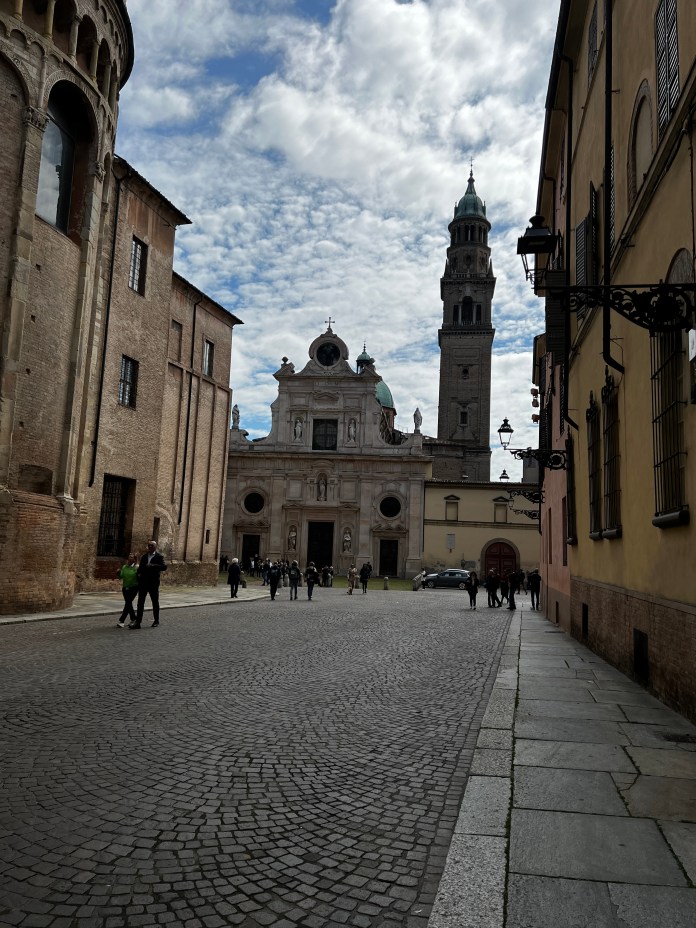
We managed to visit Parma’s beautiful cathedral and monastery, followed by lunch at a really cool restaurant where blues were accompanying the delicious food. Below are some photos of our day. Again, masks were required at that time, but as of May 1, 2022, masks are mostly only needed on public transport, in medical settings and nursing homes, and in sports venues, concert halls, or theaters. I note, once again, that Italy is stricter than Germany is right now. One of these days, I’m going to make a video of all the beautiful cathedrals I’ve seen in Europe.

A busker entertained us with Bach. He made me cry.

The monastery is located very close by the Parma Duomo. We had to wear FFP2 masks to see the library.

After more walking around, and more photos taken, we found our way to a quiet little plaza where we had lunch at a restaurant called Osteria del Teatro. This was a cute and popular place where excellent blues music paired with really nice local dishes and wines. Old vinyl records were used as placemats!

Below are some more photos from our day in Parma. Some decorations are in honor of the holiday.

By late afternoon, we were ready to go back to the B&B and drink more wine… which we did.

After our wine break, we watched old American shows dubbed into Italian… The Dukes of Hazzard, The A Team, and Walker, Texas Ranger! No wonder I saw so many Confederate battle flags in Italy.

Standard
Baden-Württemberg, Sundays

Heavenly hiking at the Allerheiligen Wasserfälle

Still chasing waterfalls in the Black Forest!

On May 19th of this year, Bill and I paid a visit to the lovely Burgbach Wasserfall in Bad Rippoldsau.  On that day, we had made tentative plans to also visit the Allerheiligen Wasserfälle (All Saints Waterfalls), which I found out about when I read this guy’s blog about waterfalls in Europe.  His post about the Allerheiligen falls led me to believe they weren’t anything special.  I was also thinking they were closer to Bad Rippoldsau than they are.  We couldn’t visit the All Saints falls on May 19th because while we were eating lunch, the sky opened up with rain.  Having now been to the Allerheiligen Wasserfälle, I’m pretty glad we chose to visit them on a different day.  The visit was a lot more intense than I was expecting.

We left the house at a few minutes past noon and made the trip to the Black Forest National Park.  The falls are located just north of the village of Oppenau.  As usual, we enjoyed a lovely ride through the Black Forest, past Freudenstadt and Kniebis.  The only thing that made it a little stressful were the many bikers sharing the road with us.  The Black Forest is very beautiful, and it attracts motorcycle enthusiasts in droves.  They can be rather aggressive in their need for speed.  More on that later.

A lot of people had the same idea we did.  We arrived at the falls at about 1:00pm and the first parking lots we encountered were pretty full.  We parked on the street, where there are a number of spots available.  Here’s another hint.  Keep going past those first lots and you will eventually find the main entrance to the waterfalls.  There is also a large, free parking lot there.  On the other hand, if you want to eat before you hike, parking at the first lots will get you close to the very good gasthaus there.

A lovely view of the mountains, meadow, and a war memorial honoring men who died during World War I.

Besides the majestic waterfalls, Allerheiligen is also the site of a ruined monastery, the foundation of which originated in 1192.  Evidently, the site of the monastery was determined by a donkey, which threw off a sack of money in the area.  A wooden chapel was built, and by 1657, it became an abbey.  The Allerheiligen Kloster was at the height of its power during the 18th century, but in 1802,  Margrave Karl Friedrich of Baden began a course of secularization.  He dissolved the abbey and took all of its possessions.  The monastery was already damaged by several large fires between 1405 and 1555.  In 1804, there was another fire caused by a bolt of lightning.  It wasn’t until the end of the 19th century, when people started to tour the Black Forest, that anyone thought to preserve what was left of the ruins.  So many years later, they are still very interesting and kind of majestic in their starkness.

We encountered the ruins first, as they were at the end of the trail we took from our roadside parking spot.  Below are some pictures.

Now you see Bill…

Now you don’t.

This creek eventually turns into the waterfalls…

A more modern church on the hillside.  We didn’t investigate it because frankly, after walking up and down the falls, we were exhausted!

If you like photography, this is a beautiful place to be.  There’s a lot of interesting scenery.


The gaststätte is conveniently located next to the ruins.  Bill and I arrived just in time to snag a table. The hardworking staff was busy the whole time we were there and no table stayed empty for long.  We sat down next to two tables consisting of two couples with kids.  I’m pretty sure the husband of one couple was German.  Everyone else was very obviously American and spoke loudly enough for everyone to know from where they came.  It made me chuckle.

A very slender and extremely friendly lady took our order.  She spoke some English and was relentlessly chipper.  I admired how much she seemed to enjoy her work.  She was all smiles.  I used to wait tables myself and I can promise that I struggled to smile a lot when I was doing that work.  It was truly a pleasure to be served by her, though.  Not only that, but the food at the restaurant was surprisingly good.

Bill peruses the menu, which was passed to us by a nice guy at the next table.

Bill settled on Schweinebraten, which was served with brown gravy and a mound of delicious mashed potatoes.

I had fresh trout, topped with toasted almonds and served with mashed potatoes.  Those potatoes were off the chain!  They were very buttery and delicious!  It was such a treat!  I don’t remember ever being served mashed potatoes at a German restaurant before, but these would have made my mother proud.  We both enjoyed Weizen beers.


The food at the gaststätte is typically German.  They do have vegetarian selections and both a children’s menu and a menu for seniors.  We were pretty full after lunch, but I had to try the Black Forest cake.  All told, we spent 46 euros.

We shared a piece.  It was delicious.  Definitely not what you’d find at Busch Gardens in Virginia.  I used to decorate the fake Black Forest Cakes there. 

As we were about to leave, a group of bikers sat at the table next to ours.  It was good that we were leaving, since they pulled out their cigarettes and clearly intended to foul the air with smoke.  Sorry… I don’t mind smokers unless I am forced to sit next to them, especially when I’m eating.  But we were on our way to the falls by the time they lit up, so it was all good.  

Another shot of the ruins.

They were still busy when we left… and when we came back an hour later.  This restaurant only runs until 6:30pm, but it appears they work all day.  We thought it was well worth the trip.

There is a public restroom.  It’s not the cleanest and the doors have locks on them that require 20 euro cents to open.  I didn’t have to pay, though, because I got one that was left open by someone else.

A small museum with three rooms in it.  If you can read German, you can learn more about the history of the Allerheiligen monastery.

A fountain.

As you walk toward the falls, you encounter a fork.  If you go straight, you will go straight to the waterfalls.  If you bear left, you climb a gentle hill to the war memorial I mentioned earlier and pictured below.

You can unlatch the gate and look at the memorial close up.  We chose not to, which in retrospect was a wise decision.  We had many steps in our future.

You’re not supposed to wade or swim in the creek.  However, we saw plenty of people ignoring these ubiquitous signs.  We even saw one group that were actually wearing bathing suits and in the water.  Not saying you should do it, but I will say that there was no one policing.

The walk to the waterfalls is pleasant, easy, and flat.  You don’t know what’s coming…

 At the beginning of this post, I mentioned that we parked at the first parking area we encountered.  I think that was a mistake, even though I wanted to have lunch before we started our hike.  If you start at the top of the falls, you will get tired going down.  Then you will have to turn around and hike back up.  The hike up is a lot more strenuous than the hike down is.  There are seven levels, most of which aren’t steep drops.  However, at the bottom of the system, there are two big falls with many steps to climb up and down.  Keep that in mind if you visit.  Also… do not come to the falls with a stroller or a wheelchair.  This is a moderately difficult walk and requires participants to be able bodied or carried.

Below are photos from the walk down the falls.  It was fairly busy today, so a lot of people were taking pictures.  I think I did a pretty good job of not including most of them in my shots!  It took us about an hour to hike down and back, with another hour or so for a leisurely lunch.  If you have a lot of energy, you could combine this activity with another one.

One of the steep staircases to climb.

And a look at just how far down the mountain you are…

At the end of the falls, as we were approaching the main entrance.

Piles of rocks left by other visitors.

A map of the area.  If you wanted to, you could do a lot of heavy duty hiking here.

This is a picture of the main entrance– seems most people use it.

We turned around and started walking back.  This is a sign warning against winter visits, when the falls are closed.  I would imagine it would be dangerous to walk along the falls when it’s very icy.

A chair?  I sure could have used one.

Another long trip up the stairs!  Good thing I have a strong heart!

Although it didn’t take long to visit the Allerheiligen Wasserfälle, it was a challenging walk for Bill and me.  I was alternately panting, sweating, and thanking God I’m still able to do these kinds of activities.  I thought of my mom as I was climbing the steps.  She’s turning 80 in August and can no longer walk like she used to.  She would not have been able to enjoy the beautiful waterfalls here.  On the other hand, we did see a number of very fit seniors visiting this natural wonder.  So I will keep hauling my ass up the hills and taking pictures.  Even if I sometimes grouse at the hard physical work, crowds, and stinging nettle plants, I am never sorry I do these day trips.  I always come away better off for having made the effort to visit.

I was tempted to hike up and down this very short but steep shortcut.  But then I remembered being stung by plants yesterday and decided not to cheat.

One last shot…

 Now… earlier in this post, I mentioned the bikers and how they were creating a bit of a hazard on the road to the waterfalls.  Those of you who ride motorcycles should pay close attention.  Bill and I got in the car and started heading home.  My cell phone had absolutely no signal in the area.  While this was initially a nuisance for an Internet addict like me, it actually became what might have been a matter of life or death.

As we were driving along the road between where we parked and where the main entrance to the falls are, we passed a young woman dressed in biker garb.  I noticed that she looked very distraught.  She waved at us to slow down.  As we approached a sharp bend, I could see why she was waving.  There was a small group of bikers on the side of the road, next to the treelined cliff.  A young man stood in the middle of the road and flagged us down.  He motioned for us to lower the window and asked us if we had a “handy” (cell phone).  Bill and I were confused as to what was going on, but the look on his face told us something bad had just happened.  Clearly, he was hoping I had a signal so he could call for help.

I noticed the groups’ bikes were parked nearby and a couple of the men were looking over the edge of the mountain.  I can’t be sure, but it appeared that a very serious accident had just occurred.  Bill and I surmised that perhaps a member of their group had been unable to negotiate the turn and went over.  I don’t know this for sure, though… only that the people in that group appeared to be very upset.  It looked like whatever had happened had only just happened.  Hopefully, whoever came after us was more helpful than we were and no one was either hurt or killed.  But that’s sure the way it looked.

So if you ride a motorcycle, please slow down and be careful, especially on the very curvy mountain roads at high altitudes.  We saw an awful lot of people taking stupid chances today, even if we hadn’t run into this distressed looking group.

Edited to add:  Here’s a news report about the accident.  Our impressions were correct.  Looks like he survived.

Oppenau (ots) – On the county road 5370 between Allerheiligen and Oppenau came on Sunday afternoon at 16:25 clock a 47-year-old motorcyclist alone involved in a right turn to fall. The driver of a group of four slipped over the road after the fall and threw first against a tree on the left lane side and in the sequence down a slope. The man was seriously injured about 50 meters below the road to lie down, his admitted in France two-wheelers crashed about 80 meters in depth. The casualty was hospitalized in a hospital. During the extensive recovery, the county road was closed for about 2 hours. The damage to the bike is around 12,000 euros.

Minutes after we passed the guys on the side of the road, we passed the main entrance.  If we had parked there, we probably would have missed the whole drama.

It was a really beautiful day to visit the waterfalls.  And… I was thanking God we did it in June instead of late July or August!  I was still radiating heat when we got to the car.  By the way… it doesn’t cost anything to visit these falls.  Frankly, I thought they were gorgeous.  Triberg may have Germany’s highest falls, but I think Allerheiligen’s falls are much prettier.  In fact, I also liked them better than the falls at Bad Urach.  If you like waterfalls, I definitely recommend a trip to the Allerheiligen Wasserfälle.

Below are just a few photos I took on the way home.  The route took us a different way than we’d ever been before.  Oppenau looks like a really nice town.  I may have to explore there next.

Standard
Sundays

Bluer than blue at Blautopf…

Breathtakingly blue…

Sometime a couple of months ago, a person in our local Facebook group asked where to find a certain “blue lake” near Stuttgart.  A German member of the group supplied the answer to her query.  She was looking for Blautopf (Blue Pot), a beautiful spring in the town of Blaubeuren that feeds into the River Blau and eventually the Danube.  I was curious about Blautopf; I had never heard of it until it was mentioned on Facebook.  Once I saw pictures, I decided Bill and I needed to visit.

Going to Blautopf from Unterjettingen was a bit of a hard sell, though.  The town of Blaubeuren is a somewhat stout drive from where we live.  It’s somewhat close to Ulm.  Since we didn’t plan to bring our dogs, Zane and Arran, with us, it would mean they’d spend several hours home alone.  We had such pretty weather this weekend, though, that I finally wore down Bill’s resolve and off we went.  The drive took about 80 minutes on B28.  Alternatively, we could have gotten there by way of A8.  We also could have brought our dogs with us.  Blautopf is very dog friendly.

On the way to Blautopf, we passed through Pfäffingen, the town where Bill and I lived the first time we were in the Stuttgart area.  As we drove through, I noticed a very large man standing on the side of the road with his thumb up.  He was looking at us hopefully.  Alas, even if we were in the habit of picking up hitchhikers, we were in my Mini Cooper, which really accommodates only two adults, despite the presence of a backseat.  I was thinking to myself, “Dude, we’re in a Mini.  Even if we wanted to give you a lift, where would you sit?”

My first view of the town of Blaubeuren, which is very tourist friendly.  There’s lots of parking, although even in late March the town was full of people visiting the spring.  I imagine it gets packed there in the summer.

We stopped by the public WC, where I spotted this cute little poem…

Then we followed the crowd and the blue arrows pointing to the point of interest…

The spring feeds into a mill, which fuels a hammermill.  There is a museum where visitors can see horseshoes being made, among other things.  We stopped in after we gazed at the beautiful water.

The water gets to be about 69 feet deep in the middle.

Here they show how deep the water is at any given time.

The inside of the hammersmith.  We basically just observed all that was going on in there because it was pretty loud and the whole thing was in German anyway.  But we were able to see how the water fueled the machinery and it was well worth the visit.  It was also a cheap attraction.  An adult ticket is 2,50 euros.

It costs nothing to visit Blautopf, probably because it only takes a few minutes to see it.  Those who are feeling energetic can hike up the mountain to get some great views of the charming town.  There are also several museums and a monastery.  If we hadn’t been worried about leaving the dogs for too long, we might have stayed a little bit longer and taken in more of the sights.  Instead, we decided to stop by Gasthof Blautopf- La Locanda for lunch.  That was a good choice.  The food was outstanding.

Bill enjoys the sunshine as we wait for beer.

I love a good Franziskaner.

This particular restaurant has an advantage of being located very close to the spring.  I also noticed that there was a lovely aroma coming from the terrace.  When we sat down, I noticed a guy sitting near us who had ordered pasta.  The tomato sauce smelled so good that I decided I had to have that for lunch.

Bill ordered Spaghetti Principessa, which was spaghetti with olive oil, algae (which sounds weirder than it is), cherry tomatoes, capers, rucola, pine nuts, and very fresh shrimp.  It was delicious!  I wished I’d ordered it.  But I went with the more pedestrian Spaghetti Mediterana.

This was also an excellent dish.  The sauce was made of very fresh tomatoes, basil, and olive oil.  It was topped with Parmesan cheese.  

Service was friendly and the prices were very fair.  Our lunch was under 30 euros before the tip.

The monastery.

A map of the town.

Here are a few more shots I took with my new camera…


A pair of mallards were enjoying the pristine water.

I would definitely recommend Blautopf for a fun day trip from the Stuttgart area.  Although we didn’t do anything more than see the spring and the hammersmith museum, we could have taken the whole day to see other places along the way.  Our route took us past Bad Urach, where there are waterfalls and ruins, Reutlingen, and Tuebingen… all places where one can have lunch and fill up the day with activities.  If you visit during the summer months, you can also stop in nearby Laichingen and see the Tiefenhoehle, which is part of the cave system that forms Blautopf.

Standard