Here it is… my usual ten things I learned post. I like to do these lists after I take a trip, to remind me that travel isn’t just about changing scenery; it’s also about making discoveries and becoming smarter. I also find that people tend to like these more concise posts about my travels. So, here goes… ten things I learned in Belgium and The Netherlands!
10. There’s some really good food in Mons, Belgium. Bill and I were pleasantly surprised by the number of good restaurants in Mons, as well as the variety of different cuisines. They had everything from sushi to cous cous!
9. Delhaize– a grocery store in Belgium– owns Food Lion in the United States. When we were in Mons, I noticed a grocery store called Delhaize, which had a logo that looked like the one used for Food Lion grocery stores in the United States. Well, it turns out Food Lion was purchased by Delhaize in 1974!
8. Germany shut down all of its nuclear power plants as of 2023. This tidbit came up as we were passing what appeared to be a functioning nuclear power plant in Germany. I took a picture of it and included it in one of my posts. A German friend explained that nukes are “out” in Germany. I’m not sure what was going on with the place we passed, though. It sure looked like a nuclear power plant that was functioning. And it was located in Germany.
7. There is a concentration camp near the Dutch town of Den Bosch. I found this out as I was writing about our visit to Den Bosch and learned that from 1943-44, the Germans ran a concentration camp there known as Herzogenbusch.
6. Tipping is not much of a thing in The Netherlands. I probably knew this after an earlier visit, but it became clear again when we visited this time. Bill tried to round up a bill at a restaurant and the lady who took his money asked him if he was sure. Same thing when we checked out of The Duke Suites. There seemed to be no expectation of a tip. It was quite nice.
5. Some businesses don’t take foreign based credit cards in The Netherlands. This issue is slowly being resolved now, but we did run into a business that couldn’t take our American credit cards. If you don’t have an EU issued credit card, you may want to carry some cash with you, just in case. Mastercard/Maestro seems to be the preferred card in The Netherlands.
4. Facebook ads can lead a person to beautiful places… I found The Duke Suites through a Facebook ad. I’m so glad I did. We had a fantastic time there, even though we aren’t golfers.
3. Dutch beers are tiny. Okay, so I kind of knew this, already. But when you live in Germany, where you can buy draft beers by the half liter or more, it can be a shock to order one in The Netherlands and have it come in a .33 liter glass!
2. If we ever go back to Mons, we’ll stay in a different hotel. Self-explanatory.
And finally number 1… Sometimes visiting lesser known places can turn into unforgettable experiences… I had never heard of Nistelrode when I discovered The Duke Suites. It’s certainly not a place that is high on most Americans’ radar. But I’m glad we did visit there, because that place made our 22nd wedding anniversary very special and unforgettable. I hope we can spend more time in Holland. It is a very beautiful country with wonderful people!
Although our trip to Bad Wörishofen was fairly mundane, I did learn some new things on our most recent trip to Bavaria. So… in the interest of keeping things regular, here’s my usual ten things I learned list about our most recent road trip.
10. Bad Wörishofen is a place where older people like to go and have a rest. Self-explanatory… although I guess Bill and I are approaching the status of “older people.” We noticed a lot of older folks visiting, but we also saw a lot of senior residences.
9. Sebastian Kneipp was a German Catholic priest who discovered the Kneipp Cure. I had heard of Kneipp therapy before we visited Bad Wörishofen, as I encountered a Kneipp pool when we lived near Stuttgart. But this therapy, which involves a balanced diet, exercise, fresh air, and walking in cold water was discovered by Kneipp in Bad Wörishofen. And if you visit there, you won’t be able to forget it.
8. Bad Wörishofen looks like maybe it’s losing popularity… I’m sure there’s an explanation as to why there were so many empty storefronts in Bad Wörishofen. Maybe it has nothing to do with waning popularity in the spa town. Still, Bill and I both noticed that there were a lot of empty rental spaces there.
7. If you get bored in Bad Wörishofen, you can easily visit other places.
We weren’t in Bad Wörishofen long enough to venture out of the spa town, but if we’d wanted to, we could have easily visited several well known German cities. That means it might make for a good base for those who want a small town feel and access to cities like Augsburg, Lindau, and Munich.
6. Five star hotels don’t always offer five star service.
I already knew this before we visit Hotel Fontenay. Five star hotels in Europe can be perfectly mediocre, as the star rating is more about the amenities offered, rather than extraordinary service. Hotel Fontenay is technically a five star hotel, but although the facility is nice, and the people are friendly, there was definitely room for improvement.
5. In Bad Wörishofen, you can try the water cure by simply walking into the old town.
I was surprised to see a Kneipp station in a pavilion in the old town in Bad Wörishofen. Anyone can go there, roll up their pants, take off their shoes, and walk in the water. The town has Kneipp stations all over it, allowing visitors to try the water cure.
4. But if you want more professional spa treatments, you can easily find them. We noticed many places where professionally administered Kneipp therapy cures were offered. Maybe we should have done more research about them before our arrival on Thursday.
3. If you get hungry, head for the train station… This was where we found the excellent restaurant, Unsere Liebhaberei, which offers unique dishes, good wines, and friendly service. I think visiting this restaurant was the highlight of our trip.
2. There’s a free bike repair station in Bad Wörishofen. Seriously… if you happen to be riding a bike and break down in this spa town, you can head to a helpful bike repair station with tools that are connected by a sturdy wire. I don’t know how many people have availed themselves of the station, but it was the first time I’d ever seen anything like that. However, I do remember seeing a tire pump station in Jettingen, where we lived before we moved to Wiesbaden.
1. People take All Saints’ Day seriously in Bad Wörishofen. I’m sure they take it seriously in other parts of Germany, too. But this Bavarian town really seemed to observe the religious holiday. Even our hotel had hymns playing over the sound system!
I’m not sorry we went to Bad Wörishofen. I thought it was a very pleasant town. I enjoyed learning more about Sebastian Kneipp, although I will confess that I didn’t try the water cure during our visit, because it was just too chilly for me. I did notice some people tried it, though, as there were always wet footprints by the pool in the Dorfplatz. I wouldn’t necessarily mind going back to this spa town, maybe at a different time of year. I would choose a different hotel, though.
That about does it for my series on Bad Wörishofen. Now I’m off to have a good cry.
Here it is, my usual top ten list of things I learned on our most recent trip. This time it’s Iceland, a country we’ve been wanting to visit together for a long time. I probably learned more than ten things on this trip, come to think of it. So here goes…
10. Be sure to bring waterproof clothing with you to Iceland!
Iceland is one of those places where you just never know what kind of weather you’re going to get. One thing is a sure bet, though, and that is that it’s likely to rain. We now know from personal experience that an umbrella is not likely to be that helpful, especially outside of the city. So, if you’re planning a trip to Iceland, you may want to invest in waterproof clothes. A raincoat is essential, and you’ll probably want waterproof pants, too. But if you need waterproof clothes, don’t worry. Icewear is a handy store with many outlets in Iceland. They can hook you up with clothes and footwear! Dress in layers!
9. Icelandic horses are just that… HORSES.
I grew up around horses and ponies in Virginia. Where I come from, a person would take one look at an Icelandic horse and think they were seeing a pony. Not so… Icelanders consider Icelandic equines to be HORSES, even though they are shorter and smaller than what a lot of us would consider horses.
8. Any Icelandic horse who leaves Iceland is not allowed to return.
Iceland is very strict about the import of animals. It’s possible to bring pets to Iceland, but there are exacting procedures and they have to be quarantined for at least three weeks. And when it comes to Icelandic horses, which are the only horses on the island, they can never return to Iceland if they ever leave.
7. There are evergreens in Iceland, but they were imported from Alaska!
Our guide, Ivar, pointed out evergreen forests during our tour and he said that the trees, along with Alaskan lupine, were imported to Iceland from the U.S. state of Alaska. Ivar said that prior to the import, most of the trees in Iceland were birches.
6. The only animal native to Iceland is the Arctic fox.
Other animals have been introduced, of course. At one point, Norway sent reindeer to Iceland. Most of them died, but enough survived that they exist on the island. Sometimes polar bears from Greenland show up near the coasts, but Ivar told us that the authorities usually shoot them because Greenland doesn’t usually want them back. It makes me kind of sad to think of polar bears being killed in such a way, but I’ve also read that many of them are starving, anyway, due to a lack of fish and other prey caused by global warming.
5. All physically capable schoolchildren in Iceland must learn how to swim.
Ivar told us that his wife works at a school teaching kids how to swim. It’s required of Icelandic children because there’s so much water in and around the island. I was reminded of how I had to prove I could swim before I could graduate Longwood College (now Longwood University). My college has since done away with that requirement, but I doubt Iceland ever will.
4. Tourism is a mixed bag in Iceland.
There are still parts of Iceland that are very remote and rugged. It wasn’t until very recently that Iceland became a hot tourist destination. Consequently, the locals are dealing with some mixed consequences of the trend. On one hand, places that used to be special and pristine are now teeming with tourists. On the other hand, tourism has brought in more workers from other places, increasing population. Tourism also brings in new facilities, such as public restrooms, and better restaurants, as well as lots of money!
3. Iceland is extremely welcoming to LGBTQI people. It’s also got a long history of promoting women’s rights.
There’s even a rainbow colored street in Reykjavik!
2. Icelandic is the language from which other Nordic languages, except Finnish, sprang.
Ivar told us that Danish, Swedish, and Norwegian used to be more like Icelandic, but due to business dealings with Germany, they changed some of their words to be more like German. I did notice when we were in Norway and Sweden last year that some of their words were like German words.
1. If you want to tour Iceland properly, you should definitely consider hiring a guide!
This was the first trip Bill and I have ever taken for which we’ve done a “bespoke” tour. I’m not sure why I realized hiring a guide would be a good idea, especially since I neglected to buy waterproof pants. However, it was absolutely the RIGHT decision for us. We saw parts of Iceland there’s no way we ever could have seen on our own. Moreover, we witnessed what can happen to people who try to drive in Iceland and aren’t wary of the pitfalls. Remember that picture of the half submerged rental car?
Yes, it was expensive for us to book Iceland Luxury Tours, but they did a fantastic job planning our vacation and looking after us. We would not hesitate to recommend them! But even if you don’t want to book luxury, I would definitely shop around for a qualified guide, preferably one who has access to a four wheel drive vehicle! The right vehicle with adequate insurance is an absolute MUST if you want to go to the rugged highlands.
If you decide to visit Iceland, be sure to save up for it. It’s an expensive place to visit. But don’t let that put you off, because as brutal as Iceland’s weather can be, the people are so warm hearted and kind. And the beauty of the country is unparalleled. It really is an incredible place with views you won’t get in many other places on Earth.
We are so glad we finally made it to Iceland. I do hope we can visit again, maybe at a different time of year. I can’t promise the weather will be better, but I’ll bet the views will be different!
Alrighty, then. This should be the last Bulgaria post for our most recent trip to the Balkan country on the Black Sea. If you’re a regular reader, you may already know that I almost always cap off my trips with “ten things I learned” lists. Some people seem to like these over the blow by blow chronicles. So here goes.
10. Bulgaria’s time is an hour ahead of Germany’s. When my friend Elaine and I visited Bulgaria in 1996, we went by bus and traveled from Armenia through Georgia and Turkey to get there. We crossed two time zones, which was kind of bizarre, because in spite of its huge size, all of Turkey was in the same time zone. That meant there was a two hour difference between Georgia’s time and Turkey’s. Now, Georgia, Turkey, and Armenia have stopped changing the clocks in the summer, so the time difference between Turkey and Georgia is only one hour. And Bulgaria is far enough east from Germany that it’s one hour ahead of us. Bulgaria still observes Daylight Savings Time.
I should have tried this.
9. English is widely used in Sofia. I don’t know how it is in the smaller cities and towns of Bulgaria, but I was amazed by how many people spoke excellent English in Sofia. That was not the case when Elaine and I visited in 1996. I only encountered one person who wasn’t an English speaker on last week’s trip.
8. McDonald’s are everywhere in Sofia! When I visited Sofia in 1996, there were only two McDonald’s restaurants in the entire country. The first McDonald’s in Bulgaria was opened in December 1994 in Plovdiv. The second one opened in 1995 in Slaveikov Square. During my visit in 1996, I spent a lot of time loitering near that McDonald’s, because Elaine and I had crashed with a Peace Corps Volunteer, and Elaine had gone to visit a friend of hers. One day, I kind of got lost wandering around Sofia, and ended up taking a taxi. The driver didn’t speak English, so I asked him to take me to McDonald’s. I couldn’t do that trick today, though, because Sofia has McDonald’s all over the place. I understand they’re not so popular anymore, though, because there are many BETTER restaurants in Sofia now!
Follow the Yellow Brick Road!
7. Sofia’s iconic golden bricked road was meant to make the city look more like a “capital”. Both times I visited Sofia, I wondered about the yellow bricked roads in the center of town. They are very unusual looking, especially compared to other parts of the city, where it’s easy to see shabby buildings from the communist era, crumbling from age. I researched the yellow bricks and learned that they date from the early 1900s, some years after Bulgaria was liberated from the Ottoman Empire and Sofia was named its capital. Sofia was chosen because of its location, and not because of its beauty. In those days, the city didn’t have much decent architecture to speak of. In 1907, Sofia’s mayor, Martin Todorov, decided that the city needed something unique. He decided on the yellow cobblestones, which cost a lot of money, but definitely gave Sofia some sparkle. Nowadays, the yellow bricks are a challenge, because they aren’t so easy to procure when they become damaged and need to be replaced.
Not quite free beer.
6. Sofia is still relatively cheap to visit. While the city has luxury accommodations and restaurants, they are less expensive than in other cities. Taxis are also easy to use and won’t break the bank. But if you prefer an even cheaper option, you can take Sofia’s metro or one of its many trams. Or, you can do what Bill and I did, and just walk everywhere. Sofia is a pretty walkable city.
5. Sofia is home to religions of all kinds… and they all seem to coexist peacefully. If you walk through Sofia, you will see many interesting religious buildings. The oldest one dates from the fourth century! But not only will you find churches, but you will also find a synagogue and a mosque, and they all operate near each other, apparently in basic harmony.
4. If you plan to visit Sofia’s famous Alexander Nevsky Cathedral in the summer, be sure to cover your limbs. This is a basic truth for many religious sites, but I’ve found it to be especially true in orthodox churches. You should not attempt to visit when you’re wearing shorts, skimpy sundresses, or otherwise indiscreet clothing. You may be asked to leave or cover up if you ignore this advice.
3. Be sure to stop by the flea market outside of the cathedral. In 1996, I bought a small painting at that flea market. I remember paying the Bulgarian lev equivalent of about $6 for it. In retrospect, I wish I’d bought another. The artist had a few similar ones for sale. We went again on Monday and bought two more paintings that I love, although I saw a few on Saturday that I thought were even more interesting. I noticed in Armenia and Bulgaria that Saturdays are the best times to visit markets, if you want to find something cool for your home.
2. Bulgaria is a fascinating mix of different cultures. The language is Cyrillic and sounds a lot like Russian, but the weather is more like Turkey and Greece. The food is a tantalizing mixture of different cultures, and you can also enjoy excellent beers, wines, and juices. I wish we could have gone outside of Sofia on this trip, as I know firsthand that Bulgaria has a lot to offer beyond the capital city. I want to go back and visit caves and hang out at the beach.
And finally 1. Sofia is a great place to go if you’re not wanting to be overrun by tourists… I was kind of surprised that there were Americans in Sofia, but there were not nearly as many as there likely are in Dubrovnik right now. We were originally thinking of going to Dubrovnik, since that was the location Bill picked out of the Champagne bucket. I’m glad we went to Sofia, instead. It was fun seeing the city again after so many years… and it’s still a pretty authentic place to go, even though there’s been a lot of business development since 1996. I wish we hadn’t gotten sick, but at least we’re on the mend now. After my upcoming medical journey, we’ll plan our next adventure. At this point, it looks like it’s going to be Iceland…
If you’re a regular reader of my travel blog, you know that I like to wrap up our trips with a ten things I learned post. It kind of helps me sum things up succinctly, as is hand for those who don’t want to read the blow by blow journal. So, I now humbly present to you ten things I learned while we visited the Freiburg region of Germany!
10. Freiburg has a thriving wine culture. We noticed a number of wineries as we headed down to Horben. If we’d had another day or two, maybe we would have visited a few wineries and tried more of the local wines and brought some home. One of the sommeliers in training reminded us that the region is very close to France’s Burgundy region, so there are some good wines to be had from Freiburg. There are also, naturally, some excellent beers, and some places are embracing the alcohol free cocktail trend, too.
Schauinsland is a must see on a clear day…
9. The Schauinsland cable car takes about twenty minutes, but you get a gorgeous view of the countryside. The Schauinsland rises 1284 meters as it takes riders up the mountainside, where they can enjoy hiking, biking, dog walking, and the miner’s museum. It’s also a great place for lunch or even breakfast at Die Bergstation. Be sure to make a reservation if you want to try breakfast, though.
Lunch in France!
8. If you get bored with Freiburg, you can easily visit France and/or Switzerland. Both borders are very close to Freiburg. I was thinking we might venture into Switzerland at some point during our visit, but Freiburg had so much to offer that we never had the opportunity.
So many bikers…
7. If you want to visit Freiburg, you might want to walk, take the bus, or ride a bike… Freiburg is a “green” city. It’s not very car friendly at all, as we found out when we tried to find a parking garage and ended up in a Walkplatz, where people were quick to give us dirty looks and gestures. I would like to visit Freiburg proper, but not when we have to worry about driving.
On the way into Freiburg from Horben… They issued a few hand gestures.
6. Freiburg is heaven for bikers. We saw so many people riding bikes in and around Freiburg, and lots of them were riding them up very steep mountains. My days of doing that kind of bike riding are long over, but I was impressed by the stamina and bravery of the many bikers in Freiburg. For a moment, I thought we were actually in The Netherlands!
St. Stephan’s Church rising high over Breisach.
5. Breisach is well worth a visit. We decided to visit Breisach kind of on a whim, because I noticed it was a stop on many Rhein River cruises. I wanted to give myself a reason not to ever book one, because I live about twenty minutes from the Rhein and have been to most of the stops on the majority of the available Rhein River cruises. Breisach was one place I hadn’t been. I’m glad we went there, as it is a very cute little town right on the French border. I’d like to see more.
Beautiful church in Staufen!
4. Ditto to Staufen… Staufen is a quaint, colorful, historic town I’d never heard of before we visited Freiburg. I want to thank my German connection, Susanne, for recommending it. I hope we can visit again and spend more time there.
Todtnauer Wasserfall is well worth a look!
3. The Freiburg region has a lot to offer. Not only do you get the Black Forest and stunning mountain views, but you’re also very close to the Rhein River. It’s kind of like a marriage between our two German lifestyles since we moved back here in 2014– Black Forest in the Stuttgart region, and Rhein River in the Wiesbaden region. Freiburg has them both! There are also waterfalls, a hanging bridge, and even a downhill scooter track.
He is magnificent, and he knows it…
2. Peacocks can make a visit to a small “zoo” worth the price of entry… We visited the small Schwarzwaldzoo in Waldkirch and were charmed by the animals. However, in my opinion, the preening peacock who was primed for peahen poontang was the star of the show. It was worth the 7,50 euros each to watch him strut, fanning out his beautiful tail, and showing off to everyone. What a personality!
Such a beautiful, enchanting, inspirational place… I recommend that you visit, too.
And finally, 1.– I am so glad we finally made it to Freiburg. Susanne has been after us to go there for ten years. She was right, Freiburg is well worth the trip. I’m glad we took the plunge. I hope we can take the plunge again and see even more!
One more waterfall crossed off the bucket list!
So far, this year, we’ve done two short Germany trips, plus an overnight in Stuttgart. Where will be going next? It’s anyone’s guess. It depends on when our new canine family member arrives. For now, I will keep my fond memories of beautiful Horben and Freiburg close to my heart and on my mind.
Although I’ve been to Bavaria a few times over the years I’ve lived in Germany, I haven’t spent that much time in the Franconia area of the state. The one exception is when Bill and I went to Rothenburg ob der Tauber, back in January 2018. We had a great time on that trip, in part because we had a really nice rental house in town. Rothenburg is a very touristy town, even in January, which is definitely the low season. Würzburg and Bamberg are not nearly as touristy, but they’re both well worth seeing– in part, because they’re not so touristy!
I like to write ten things I learned posts to wrap up my trips. This one is no exception. So here it is– ten things I learned in Würzburg and Bamberg.
10. If you like Rauchbier, you must visit Bamberg!
I realize that not everyone has had the chance to try Rauchbier (smoked beer). And those who have tried it, might not like it. Personally, I really enjoyed Rauchbier made by the Aecht Schlenkerla Brewery in Bamberg. It reminded me of a more flavorful Guinness. And it’s even better when it’s on draft.
Delicious, unique, smokey beer…
9. Sylvaner wines are popular in Franconia.
As we learned during our visit to Weingut am Stein, Sylvaner wines are not as well known or popular as, say, Rieslings are. But they are a very lovely grape varietal, and Würzburg is a great place to try wines made with them.
Sylvaner wines are easily explored in Franconia…
8. Bamberg is a very doable day trip from Würzburg… or vice versa.
I had been wanting to visit Bamberg, but since we were going to be bringing Bill’s mom, we needed accommodations beyond a hotel room for two. I decided to book the guest house in Würzburg, because we like our wine, and because the cities aren’t far apart. Yes, we could have driven to Bamberg, but the train offers a very convenient mode of transportation. I just wish we’d had better weather.
It’s so easy to take a train to Bamberg or vice versa.They run hourly.
7. February weather makes visiting Franconia kind of iffy…
Okay, so I knew the weather might be a problem. Years of living in Germany will do that to you. At least it wasn’t freezing cold, as it very well could have been. But we had a lot of rain, which made visiting in February less pleasant. On the other hand, it also meant a lot fewer tourists.
Stormy weather!
6. Würzburg is a great town if you love architecture and churches.
Every day, I was amazed by the many beautifully designed buildings and landmarks in Würzburg. Our vantage point at the guest house really made for some awesome views. Once again, I want to go back when the sun is shining! It’s also a place to see ramps made of Legos for a good cause!
There are steeples aplenty!
5. The Würzburger Residenz is a must see… and that’s another reason why I want to return.
We never did get a chance to tour the Residenz, other than its massive parking lot. Our wine tasting guide told us that it’s an hour or two well spent. English tours are available. Next time, we will make a point of going inside and seeing all of the riches of the impressive Residenz in Würzburg.
We’ll get back there…
4. And so is the Rathaus in Bamberg…
I really feel badly for not giving Bamberg more time. Its old Rathaus is not only adorable and unique, but it also has a porcelain museum that I’m pretty sure I would have liked to have seen. But at least I got a couple of stormy shots.
So beautiful! And there’s more to see.
3. There’s something to be said for family time, too…
Bill knows his mom won’t be around forever, so time with her is precious. We’re fortunate in that she is still very healthy and vibrant, and she gets around well. It’s an honor to spend a few days talking to Bill’s mom… and celebrating a new baby’s birth with her. Especially if you know our complicated history with Bill’s daughters…
2. We’ll do better next time we visit…
I really think our timing was off for this trip. February isn’t the best time to visit anywhere in Germany, unless you’re going skiing or something. And nowadays, even that’s kind of an iffy proposal. But February is when Parker was able to come over here, so there we are. Maybe next time we see her, my stomach will be better, too.
Vineyards, beautiful buildings, historic attractions, Lego ramps, and shopping…we have reasons to return!
1. Franconia is only 90 minutes away from where we live, and it’s different…
I think we should try to visit there for a day, if we can’t do another trip. It’s harder to do long day trips with dogs, but Noyzi’s easy enough. He likes the Hundepension, but he also likes road trips. On the other hand, if all goes well, he will have a buddy soon. So we’ll see what happens. I do think that anyone reading from Stuttgart or the Rheinland Pfalz areas should consider doing a quick trip to Franconia. I think it would make a great girls’ weekend location.
I’d go back for this bar.
That about does it for this series. Thanks to everyone who followed along with me! Time to go pack a bag for our overnight trip to Stuttgart.
Now that I’ve finished writing my blog series on visiting Armenia again, twenty-six years after I finished my Peace Corps service there, it’s time for my obligatory “ten things I learned” post. I like creating these posts because they make me think, and because they’re a lot of fun to write. Also, readers seem to like them, because they’re comprehensive, yet concise. Or, they are as concise as I tend to be, anyway. Brevity is not one of my strong suits.
Armenia has changed a lot since 1997. Even though I spent 27 months there, I still learned new things during our trip. So here goes with ten things I learned in Armenia!
Lights! Unheard of and unseen in the 90s!
10. Yerevan is now a city that doesn’t sleep!
When I lived in Yerevan, things didn’t necessarily stay open all night. There was an energy crisis. Even though it technically ended in 1995, not everyone had 24 hour power until about 1996. So, even though flights would leave and arrive in the wee hours of the mornings, things did close at night. Now, I notice that restaurants and bars stay open very late. You can buy a SIM card 24 hours a day. And there are always lights on at night. That wasn’t how it was when I lived there.
Two different versions of 1000 dram notes…
9. The drams have changed twice since I left!
Armenian drams were introduced in 1993, just after the fall of the Soviet Union. Since I arrived in 1995, I was used to the first version of Armenian drams. Now, the drams have changed their look and denominations twice since I left in 1997. When I left, the biggest bill was 5000 drams (about $12). Now, they go up to 100,000 drams!
Need a ride to Garni and Geghard? You can find one easily!
8. It’s easy to find someone to drive you to Armenia’s most famous sites.
We didn’t take any of the many aspiring drivers up on their offers to take us to Armenia’s most amazing sites, but if we’d wanted to hire a driver, it would have been easy. Our hotel offered drivers for hire, and there were many of them hanging around different parts of the city. It’s no longer necessary to go to the bus station and look for a taxi, minivan, or bus to take you to Sevan or Khor Virap. Most of them have signs in English, too.
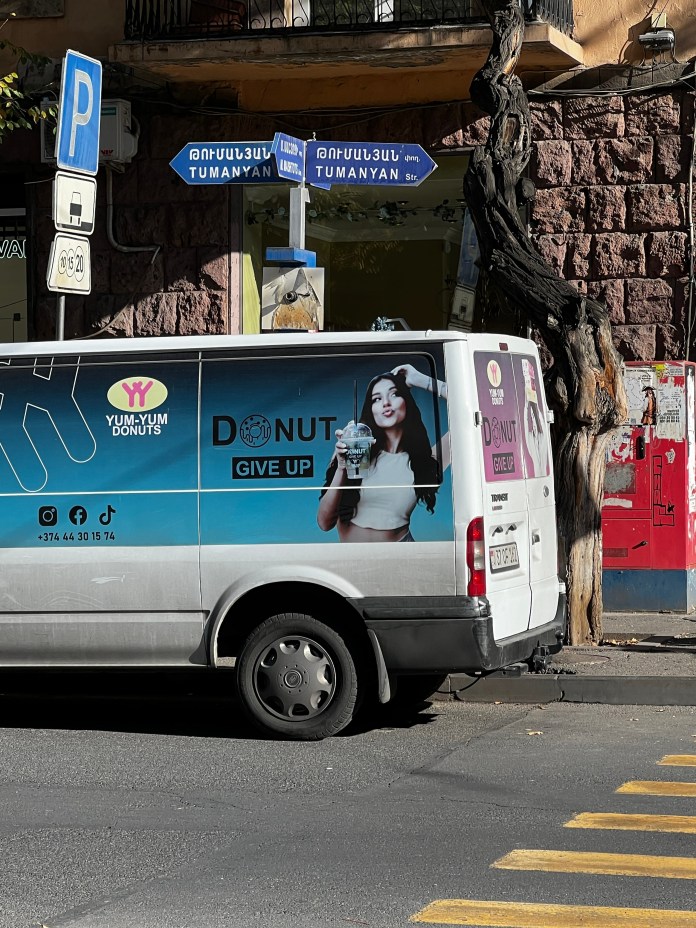
7. Speaking of English, it’s EVERYWHERE in Yerevan, now.
I saw so many signs in English. Some of them were hilariously incorrect, but just as many were hilariously witty. Obviously, there’s a movement for people to learn English, just as so many older folks had to learn Russian. I’m sure English is not required as Russian once was, but a lot of people seem to want to learn.
Cheers!
6. Armenia now has some really decent craft beers!
When I lived in Armenia, I used to joke about how bad the beers were from there. I had particularly salty things to say about Kotayk Beer, which when it was made in Armenia, was notoriously rough on the digestive system. Thanks to Dargett, a local craft beer company, you can find some good suds in Yerevan now. Now I wish I could get Dargett in GERMANY, a country well known for its excellent beers. That’s how good it was. You can also find real German beer in Armenia now. And not just the stuff made by InBev, which is a Belgian company that distributes a lot of mass produced beers. Naturally, if wine or fruit juice or even mineral water is your thing, you can find plenty of that, too. And wonderful brandy– the best I’ve ever had anywhere!
5. You can also get a beautiful meal in Yerevan…
When I first arrived in Armenia, there weren’t many restaurants at all. A few popped up while I was a Peace Corps Volunteer, but they tended to have plastic chairs and tables, and served pretty basic stuff. Now, you can get gourmet food in Yerevan… They have fine dining restaurants! And even if you go to a casual place, chances are good what you eat will look beautiful. That was one thing that didn’t change. There’s much more variety now, and some items are better quality, or are just plain available. In the 90s, we tended to eat what we could get, which meant whatever was in season. That no longer seems necessary.
Don’t be afraid to venture inside!
4. Public toilets in Yerevan are now very clean and cost 100 drams to use.
I remember many times having to duck behind bushes to relieve myself, when I lived in Yerevan in the 90s. One time, when I was out with my former language teacher, we went to a porno theater so I could pee. It was actually very clean. But most public facilities in the 90s were pretty disgusting and smelled horrible. I was very pleased to find clean restrooms in most places during our recent visit. The toilet by the Opera House was sparkling clean, well stocked, and cost 100 drams (about 25 cents). Cheap!
No longer a traditional shuka… but at least it has parking.
3. Some historic places have changed forever…
I was sad to see that the historic landmark, the Pak Shuka on Mashtots Avenue, has become a regular supermarket. I would have liked to have taken Bill in there. Ditto for what used to be the GUM, a department store on Abovian Street, and the Hayastan Market (which had changed as I was leaving). But some things are better now. For instance, the eternal flame at Tsitsernakaberd now is a true eternal flame. They leave it burning all the time, instead of just on special occasions. And the door to the Blue Mosque is now very well marked, so you can’t miss it. When I lived in Yerevan, the door to the mosque was very plain, and easy to miss. Northern Avenue is a really nice street that makes it convenient to be a pedestrian, although who knows what happened to the people who lived in the houses that were destroyed so it could be built?
Maybe we can go back and try visiting the Hrazdan Gorge again.
2. Yerevan is very safe, but that doesn’t mean there aren’t creepers there.
We ran into one of them on our wedding anniversary. He was up to no good, and not very subtle about it. However, he was acting this way in broad daylight, which was strange. I don’t know what he was up to, but I didn’t get a good feeling about it. We ended up going a different way than we planned, which worked out fine, and that was the only strange incident. It was a good reminder to always be aware and keep your wits about you. That’s good advice no matter where you go.
I bet this guy is a lot of fun to talk to… He certainly was a good singer!
And finally, 1. Although Yerevan is now a lot more modern than it used to be, and more travel friendly, it’s still very exotic and will be quite interesting to most people… and if you can speak a few words of Armenian, it will open doors for you!
I was happy that some of my old, rusty language skills came back, and I was able to speak enough Armenian to be understood by a lot of the locals. Many of them were delighted when I spoke their language… and quite a few were shocked when it turned out I wasn’t Russian. I know they get more foreigners visiting now, but it’s still not a place that is super high on the tourism list for westerners. So I would absolutely encourage adventure seekers to come visit Armenia. I would especially encourage it now, because Armenians have so much to offer; they do need the tourism drams; and sadly, if a couple of neighboring countries have their way, Armenia might someday cease to exist. So please visit, if I’ve tempted you. You will be very warmly welcomed by most! And be sure to tip 10 percent!
I want to offer special thanks to Stepan, my former student and current friend. He made us feel like FAMILY… and was so kind, welcoming, and generous. Stepan, you made this trip unforgettable, and you showed us the warmth and hospitality that Armenia is known for. It was a vacation like no other, and I will always be so grateful for all you did to make it so. So շատ շնորհակալություն! I hope we can come back again… much sooner than 26 years from now!
It’s time now for my customary “ten things I learned post”. Since this wasn’t our first time in the Czech Republic, I’ve already done a “ten things I learned” post for the country. Nevertheless, this most recent trip was very educational and entertaining on many levels. We really enjoyed ourselves, but we also learned a lot. Besides, people seem to like these summary posts better than my usual detailed postings. So here goes…
Cesky Krumlov will take your breath away… especially if you climb the castle tower.
10. Cesky Krumlov is well worth visiting for a day or two.
I mentioned that Bill and I visited Cesky Krumlov for a few hours back in 2009. I thought the town was really adorable then, and vowed to go back someday. This time, we stayed there for two nights. I think one full day in Cesky Krumlov is probably sufficient for most people, although we certainly could have enjoyed another full day there. I don’t know if I’ll go out of my way to return, but I wouldn’t object to it. It’s a beautiful town and well worth a stop if you’re in Czechia.
9. English is widely spoken in the tourist areas of Czechia.
On prior visits to Czechia, we noticed that it was helpful to speak some German. This time, we noticed that a whole lot of people are fluent in English. It’s not a given than they will be, but there’s a good chance that if you go to a touristy area, you don’t have to worry about a language barrier if you are an English speaker.
Beautiful Brno…
8. Brno is well worth a stop!
Of all the places we planned to visit when we were coming up with our itinerary, Brno intrigued me the most. I had read that it is an “up and coming” destination in Czechia. It’s not as handsome and charming as Prague is, but it’s definitely got its own vibe. And if you like caving, it’s a must visit destination, as there are several show caves there that are beautiful and worth seeing. I will never forget our visit to the Punkva Caves. I also noticed that Brno was not as heavily touristed as Prague and Cesky Krumlov. For that reason alone, it may be worth putting on your itinerary.
Choosing to eat here put us in contact with a local…
7. Someone may be watching you when you’re eating at the street food fest…
We certainly weren’t expecting to encounter an unhoused woman when we sat down to have lunch at a street food fest in Brno. But she did us a favor by eating our leftovers, and teaching us a thing or two about charity and not wasting food. And while I didn’t leave Brno with any artwork, I did leave with a memory and a great story. I doubt I’ll forget it anytime soon.
Where we spotted a very determined nutria…
6. Prague has surprising “wild kingdom” moments…
I don’t know if I’d ever heard of nutria (otherwise known as coypu) before I spotted one swimming in the Vltava River in Prague. At first, I thought maybe I was watching an otter or some kind of beaver, but I’m pretty sure I saw a nutria, an animal that has taken up residence in Prague and is apparently causing issues.
Unusual tufa cave with cauliflower rock formations.
5.If you’re near Lichtenstein Castle on the first Sunday of the warm months, you should visit Olgahöhle!
Again, this is a suggestion for those who like visiting caves. This cave is kind of special, and it’s only open on the first Sunday of the warm months. We happened to be able to visit by chance, and it was well worth the stop.
4. You can now purchase vignettes for Czechia online and there’s no longer a need for stickers.
This was a really welcome and convenient development for our trip. We were able to buy our vignette online, allowing us to use Czechia’s high speed highways. There was no need to put a sticker on the windshield. And the day before it expired, they helpfully sent a reminder email.
3. But the backroads are still in need of repair…
Our trip required some detours on secondary roads. A lot of them were in need of repair, thanks to potholes and other issues. On the other hand, they can take you to some great places, like the cool burger place we found because Bill needed to pee.
2. The people of Czechia are very warm and hospitable…
I can’t think of a single incident during our trip where we didn’t encounter very pleasant and warm people, especially in the hotels and restaurants. It definitely lent to the country’s charm and makes me want to go back again and again. This is also a great place for shopping, especially if you’re looking for art and unique toys.
Typical Czech food.
The food, wine, and beer is very hearty… but if you want to, you can easily burn it off!
I was amazed anew by how rich and filling the food was on this trip. As heavy as German food can be, I think the Czechs have them beat! But I also found myself working hard, walking, climbing stairs, enjoying nature, and burning that fuel quite handily. Czech wine is pretty decent, by the way. I might not choose it over Italian wine, but it probably deserves a lot more attention than it gets. The beer is, of course, excellent and noticeably different from Germany’s beers.
So… that about does it for our most recent trip to BW and Czechia. We meant to see our dentist in Stuttgart and take in the sights in one of our favorite European countries. We missed the dentist, but sure made up for it with good times, new experiences, new friends, and fun. I hope if you’re inspired to visit the Czech Republic, you will take the plunge! I don’t think you’ll be disappointed!
Since we used to live near Stuttgart, I wasn’t planning to write a “ten things I learned” post for our latest jaunt down there, but for some reason, I feel like writing a travel post today. Maybe it’s because I recently made a photo folder for my new computer, and it’s flashing some of my prettiest pictures, as opposed to every picture on my hard drive. A few photos from our latest visit to the Stuttgart area have been included in my photo folder.
So, to satisfy my itch to write about travel, and to maybe generate some new views, here are ten things I learned on our latest trip to Stuttgart. I do learn new things every time I travel, even when it’s to places I’ve been to many times!
10. The TV Tower (Fernsehturm) is closed on Mondays during the winter!
The Fernsehturm is located very close to the Wald Hotel. I’ve been up it twice, and although Bill doesn’t remember going up there with me, I’d swear he went on my second trip. We thought maybe we’d kill time last Monday and go up it again, but alas, it’s closed on Mondays! BUT– after April 1, you can visit on Mondays… until the winter season starts again in November.
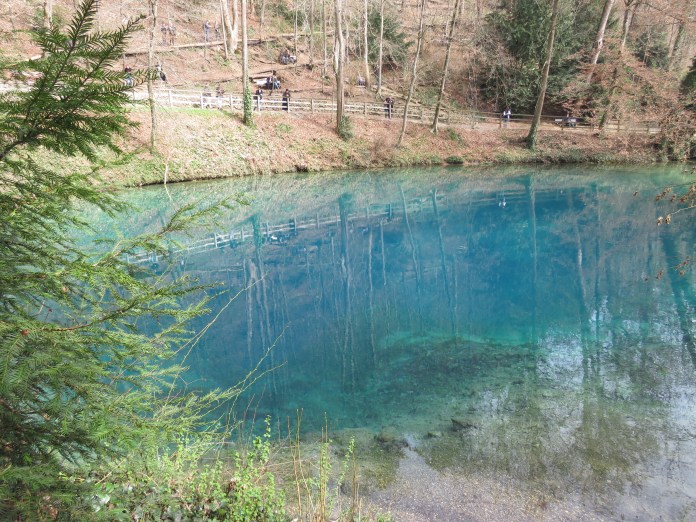
9. If you’ve already seen the Blautopf, and you liked looking at the deep blue water, you might also want to visit Brenztopf (Brenzursprung)!
I’m grateful that we were able to come back to Germany, if only because when we were living here the first time, I had never heard of Blautopf, let alone Brenztopf. These are very beautiful ponds in the cavernous areas near Ulm. Blautopf is in Blaubeuren, which is an obviously touristy town and has more facilities. It might be the “better” of the two ponds, given a choice. A visit to Blautopf can be paired with a trip to the Tiefenhöhle (Germany’s deepest show cave open to the public– also open after April 1), in nearby Laichingen.
However, Brenztopf, in Königsbronn, also shouldn’t be missed, for those who like looking at mysterious, beautiful, blue bodies of water. Below are photos from both places. The top three photos are from Blautopf, while the bottom three are from Brenztopf. Both places are probably best visited after April 1, for the “summer” season. On the other hand, if you visit before April 1, there are probably going to be fewer crowds to battle.
8. If you want to get the most out of a visit to Hohenzollern, you might want to wait until the “summer” season starts, on April 1.
It’s cheaper to visit Hohenzollern Castle in the “winter” season, because one can only see the grounds during that time. If you want to actually go into the castle and take a tour, you will need to wait for the warmer months. That is also when the Biergarten opens, although I can’t promise that an April visit will be any better weather wise than a March visit would be. If you’re short on money, a “winter” visit might be better. Tickets are significantly cheaper during the cold months.
Hohenzollern is beautiful in any season.
7. Taking the bus to Hohenzollern is so worth the money!
I mentioned in my post about Hohenzollern that Bill and I have had the experience of walking up the path to the castle. It’s definitely not for the weak. If you have any physical problems, or you’re just old and out of shape like we are, you might want to spring for the shuttle bus. Just sayin’.
6. Obviously, we need to schedule our dentist appointments AFTER April 1…
You’d think that after so many years of living in Germany, and near Stuttgart in particular, I’d already know this… But then, Bill is the one who schedules these things.
5. Besigheim is a very cute town, especially if you like German wines!
I never would have known about Besigheim if I hadn’t started following Facebook tip groups by Germans, for Germans. I wish we’d taken the time to shop for wines when we visited, but we were both eager to get to the hotel. As it was, we were still stuck in Stuttgart’s famous Staus.
4. Heidenheim is also well worth exploring, although it’s a bit of a hike from Stuttgart.
Now that we’ve seen it, maybe we’ll go back and see Schloss Hellenstein, which overlooks the town and has two museums. The castle dates from the 12th century, although the original version was almost completely destroyed in a fire back in 1530. Right next to the Schloss is a nature park, which has a bird of prey station and serves as home to many wildlife species.
3. It pays to check out restaurants thoroughly when you’re hungry.
When we visited Heidenheim, we wandered around a bit, trying to find a place for lunch. The first restaurant I spotted, La Strada, is where we ended up enjoying a lovely lunch. But we almost missed it, because although there was a menu board outside, the window next to the menu board made it look like the restaurant was deserted. All we had to do was go up a flight of stairs to find the entrance! The “deserted” room on the first floor was just another dining room that wasn’t open for lunch.
2. Always plan for a pause.
We were under the impression that La Strada had a warm kitchen throughout the day on Saturday. However, that turned out not to be the case… Our waiter was eager for us to finish up so he could take a break before the dinner shift. Not that we blame him at all for that!
Good pizza!
1. We still haven’t seen everything.
In spite of living in the Stuttgart area for a total of six years– the longest we’ve spent living in any place throughout our 20 year marriage– we still haven’t seen everything there is to see. Although Dr. Blair (our dentist) kids us, we love visiting Stuttgart and going on excursions. I always try to plan for at least a couple of outings to places that are new to us. In the future, maybe we’ll finally visit Kirchheim Unter Teck, the Porsche Museum, or the palace in Ludwigsburg.
There are also places that deserve a second or third look, like Hohenzollern and the TV Tower. Stuttgart looks different during the different seasons, or when the weather changes. I like living in Wiesbaden, and we definitely need to explore more up here, but every time I visit Stuttgart, I’m reminded of just how many things there are to do down there. I always enjoy visiting!
Overall
I often compare Stuttgart and Wiesbaden, since we’ve lived in both places. I get a lot of hits from people in the United States on my posts that compare the two places. I know this is because the two US military installations offer similar job opportunities. I want to reiterate that I’ve really enjoyed both areas, although Stuttgart remains more familiar to me, because we lived there longer, and didn’t spend two years in lockdown there. Our most recent trip was yet another reminder of how appealing both areas are, for differing reasons. But really, you can’t go wrong in either place, and on this trip, I was reminded yet again how lucky we are to be able to have and enjoy these experiences in Germany.
So… if you’re a German reading this, allow me to say “Danke sehr!” for being so welcoming and allowing us to get acquainted with your beautiful, interesting, and just plain amazing homeland! Now that I’m thinking about it, maybe next time we visit, I’ll pick a place to the east of Stuttgart to base us, so we can see even more of the places we haven’t seen yet. I’ve got until early October to make plans!
Now that my latest blog series about Hotel Bareiss is complete, here’s my usual “ten things I learned” post. I find that these top ten lists tend to get read more than my “blow by blow” posts. Let’s face it! People don’t necessarily care about the minutiae of someone else’s vacation. On the other hand, sometimes including the small details is useful for some readers, or even just to myself, as I get older and duller. 😉
Anyway, here’s my list, even though we’ve done Baiersbronn before. I see that I didn’t do a ten things I learned list for our first Baiersbronn trip, so maybe it’s good to do one now. Here goes!
10. The Hotel Bareiss experience reminds me a little of being on a cruise ship.
The first time we visited Baiersbronn for more than a couple of hours, we stayed at Hotel Engel Obertal, which is a perfectly nice hotel that offers half board. But that hotel didn’t seem to be nearly as structured as Hotel Bareiss is. Yes, lunch was included in the daily rate there, but we didn’t feel like we HAD to eat lunch there. Although we didn’t HAVE to eat dinner at Hotel Bareiss either, the very heavy service component and knowing that we were paying for the food, anyway, made us feel obligated to eat there. And while it wasn’t a bad thing at all to dine at Hotel Bareiss, that aspect made me feel a little like I was on a cruise ship. The resort offers a lot of activities, too, like a cruise ship does.
9. Hotel Bareiss is very expensive, but offers an extremely high quality product.
When I compare Hotel Bareiss to Hotel Engel Obertal, I see some obvious similarities. However, Hotel Bareiss is an institution in Baiersbronn, and people come from all over to experience it. Service is mostly top notch, and they put a lot of effort into presenting a very pleasant experience for guests. That experience will cost you, of course! But if you have the means, and you just want to relax without worrying about anything, Hotel Bareiss might be just the place to go.
8. I wouldn’t call Hotel Bareiss a very “romantic” place for couples…
Although this is a five star resort hotel with a three star Michelin restaurant, it’s also a very family friendly place. There are lots of activities available for children, and they aren’t specifically prohibited from going into places. That means you might see them in the bar, or even in the sauna area. However, I did notice that visiting in late September/early October meant that most kids were in school, so their population was at a minimum during our stay. I would not book Bareiss in the summer if I was wanting to avoid running into families with children, though.
7. Baiersbronn and the Black Forest offer a lot to do outdoors. But maybe there are not as many things to do inside. Planning for the weather is a good idea.
We suffered some rain during our visit, which made us not really want to venture out so much. A lot of the things I was thinking I’d like to do were strictly outside activities. There are some museums and other indoor activities for the resourceful, and the hotel offers excursions to nearby places like Strasbourg, France or Baden-Baden. The hotel also offers classes sometimes. For instance, they have culinary and wine courses that can be booked. I didn’t mind the rain so much, since we had such a hot, dry summer. Next time, maybe I’ll look for more inside opportunities, in case of inclement weather. Or, at the very least, I would bring clothes and shoes for wet weather. Baiersbronn is kind of a sleepy town, but there are other areas nearby that are well worth a visit.
6. Bring an extra bathing suit!
Hotel Bareiss has an AWESOME pool area, and it’s usable all year. If you like to swim or relax in the water, you may want to bring an extra bathing suit. They also have a dryer in the locker room that will wring most of the the water out in eight seconds.
5. You can bring your dog!
Although I tend to relax more when I travel without our dogs, I did miss them while we were at the Hotel Bareiss. I think Noyzi, in particular, would have loved the hotel. So many people brought their beautiful pooches with them, and there were a lot of amenities for them, including dog sitting! But bear in mind, if you do bring your dog, there are steep extra charges involved and not every room will be available to you.
4. Pack a nice outfit or two.
The Hotel Bareiss requests that guests dress nicely for dinner. That doesn’t necessarily mean putting on a dress or a suit, nor does it even mean they’ll turn you away at the door. But if you happen to be at the hotel on gala night, you will want to be dressy, as most people do put on their gladrags for the occasion. If you wear jeans and a sweatshirt, you might feel quite underdressed.
3. Don’t be afraid to try other area restaurants.
Baiersbronn is home to quite a few excellent restaurants besides the ones at Hotel Bareiss. Most are affiliated with other hotels, to include the ones at Hotel Traube Tonbach, another highly regarded hotel in the area. We ate at Traube Tonbach last year and had a very nice experience. We also tried the Meierei, which has a Michelin Plate, and liked that even more than the Michelin starred restaurant at the Traube Tonbach. But even if you aren’t into gourmet food, you can find really good eating in Baiersbronn. Especially if you like fresh trout, like I do!
2. You don’t have to spend a mint to stay in Baiersbronn…
It’s true that we dropped a load of euros at Hotel Bareiss. This year’s visit was about twice as expensive as last year’s, although we also stayed a day longer and in fancier digs. But if we’d wanted to, we could have easily bunked comfortably in less extravagant lodging and had a great time. In fact, in some ways, I think I might have preferred a less “structured” holiday. I don’t think I’m that into resorts and half board plans. I like having the freedom to try different places and do my own thing. Maybe next time we go to the Black Forest, we’ll try to find a self catering apartment in a different area.
1. On the other hand, I would NOT turn down another visit to Hotel Bareiss…
It really is a lovely hotel, with friendly and mostly professional staff, and magical surroundings. We absolutely did enjoy ourselves, and would heartily recommend that others visit. Just remember that when you book Hotel Bareiss, you’re likely to be committed to going. You may wish to purchase travel insurance, in case you need to cancel. In our situation, I was worried about Arran being sick with lymphoma and needing us to come home to take care of him. However, he has now shown us that he is clearly not ready to leave us yet… so I’m glad we didn’t cancel! In fact, as I write this, he’s visiting the vet. I have a feeling she might be pleasantly surprised by how he’s doing today.
Well, that about does it for this year’s visit to the Schwarzwald. I hope this series has been entertaining, informative, and inspirational. If you’re living in Germany, I highly recommend taking the opportunity to visit The Black Forest. We completely missed it the first time we lived here. I’m so glad we came back and rectified that tragedy! And if you are into good food, especially fine dining, you may want to make a point of visiting Baiersbronn. As I mentioned in 2018, when we first heard of Baiersbronn, there are lots of (Michelin) “stars” in them there hills!






You must be logged in to post a comment.