I mentioned in part one of this series that I had originally wanted to book us a few nights in Bamberg. Over the years we’ve been living in Germany this time, we’ve heard over and over again how great Bamberg is, and given that it used to have a US Army installation, a lot of military affiliated people know firsthand what a great town it is. I also knew about it because that’s where the famous Rauchbier (smoked beer) is made. I had tried that beer before our visit last Wednesday, but I was eager to try it on draft.
So, even though we had another cold, rainy, windy day greeting us, Bill, Parker, and I decided we’d take the train to Bamberg and see why everyone seems to love it. The train from Würzburg, which, incidentally, also used to have a US Army post, takes about an hour to reach Bamberg. We decided that was the best way to get to the city.
After breakfast, Bill drove us to the train station and managed to find a parking spot against all odds. He was very careful to buy an all day ticket (18 euros) for the lot, as the Würzburg train station is notorious for fining people who don’t pay– even if they’re only in the lot for a couple of minutes! He also bought us first class tickets for the train, which just meant we were at the front in a somewhat quieter area.
I can’t say the ride to Bamberg was especially exciting, as it was grey, dreary, and rainy. We managed to get a group of four seats and sat almost in silence the whole way. When we got to Bamberg, we walked to the center of town, where Bill had planned for us to have lunch at Schlenkerla, a historic restaurant that serves the beer and very hearty German food. I did notice that Bamberg is a very charming town. I especially enjoyed the enchanting Rathaus, which famously juts out over the middle of the Regnitz River. I didn’t get a chance to take a lot of spellbinding photos on Wednesday, due to the crappy weather. But, when we go back– and I’m sure we will– I will take more pictures.
Schlenkerla was pretty packed when we got there. I was surprised, given that it’s February, and the weather was not good. We ended up sitting at a Stammtisch, and I sat in the wrong spot. The waitress chastised me, which really annoyed me. I’m out of practice of being yelled at by Germans, having moved out of Swabia. Bill asked me if I wanted to just leave, but I sighed and said no, since we were already sitting down. I cheered up when she brought us a round of nice, fresh, Rauchbiers. I know they are an acquired taste for many, but I do like me some smokey beer.
As for food, we had more heavy German fare. Bill and his mom both got roast beef plates with vegetables and horseradish. I got a pork knuckle with sauerkraut and potato dumplings. I don’t usually get knuckles, because I can’t finish them. But the one I had on Wednesday was manageable. Bill and I also tried a Rauchweizen, which was like a wheat beer with smokey flavor. It was a bit lighter. I think Bill preferred it to the Rauchbier. By the time we finished lunch, the restaurant had emptied out.
I liked what Bill and his mom had. It was a little less extreme, too.Legendary brewery!This knuckle was delicious and not too huge.
We walked around Bamberg to burn off some of our lunch. I can’t say it was a really enjoyable walk, thanks to the wind and rain, but at least it wasn’t super cold. I managed to visit a few more churches, too, and Parker bought some gifts for her co-workers in Texas. One other thing I want to mention is the very convenient public WC near the Rathaus. That was a lifesaver after lunch! St. Elisabeth’s Church had beautiful windows on display.
St. Elisabeth’s Church…St. Martin’s Church.
Our stay in Bamberg was brief, as the weather was getting worse as the afternoon wore on. But now that I have an idea of what the town looks like, I know I want to go back and explore it some more. The train ride back was a bit more crowded, as it was quitting time. Our guide at the wine tasting mentioned that he lived in Bamberg, which probably meant he got on a train going the other direction just as we were leaving. Bamberg is definitely enchanting. Bill and I will have to go back and enjoy it when the sun is shining and Biergartens are open!
Here are a few more artsy photos of Bamberg… It really is a handsome town, even when the weather sucks.
On our first morning in Würzburg, we woke up to clouds and rain. It wasn’t a surprise, since it’s February in Germany. I was kind of sad about it, though, because I don’t enjoy walking around in the rain. Fortunately, we had a wine tasting scheduled for 3:00 PM, so that kind of limited our time in the great outdoors.
We enjoyed a breakfast of locally made Brötchen and pastries from the bakery. Bill said the lady at the bakery was kind of a character. He’d order something and she’d prompt him to buy more by saying “Und?” after he made a request. The bakery also had eggs for sale, so Bill bought a few and cooked them for our morning repast.
After drinking coffee and sharing our opinions about the morning news (King Charles’s cancer and Toby Keith’s death), we all piled into the Volvo and headed for Würzburg. Bill easily found another spot at the Residenz, and we retraced the path we’d taken the night before, when we had dinner at Wirtshaus am Dom.
I smelled pizza as we rounded the bend into the center of Würzburg. It was already late morning, which meant we’d be having lunch soon. I did mention that this was a leisurely trip, focused more on time spent with Bill’s mom in unfamiliar surroundings, than actually seeing a lot of tourist attractions. I pulled out my phone to take some photos and immediately noticed a bright, colorful ramp at a business.
On closer inspection, I could see that the ramp was made entirely of Legos! I’d never seen one of these before, but apparently they’re a thing. There’s even a firm that builds them for businesses and cafes in the city. The organization that builds these Lego ramps are trying to bring attention to the many physical barriers that still exist in public spaces, making it difficult for people who have disabilities. According to the link I provided, ten Lego ramps were built from August 2020 until January 2022, with the help of local primary school children! I had no idea, and I think this is a great project to help bring awareness to the needs of people with disabilities. I love how the people of Germany are so community minded toward everyone!
This ramp isn’t just cool looking. It serves an important cause!
As we continued down the main drag, I took note of the colorful trams that were providing service into the inner city. Then we made our way to the Dom– a Roman Catholic cathedral that dates back to 1075, and is dedicated to Saint Kilian. This cathedral is the seat of the Bishop of Würzburg, and has served as the burial place for the Prince-Bishops of Würzburg for hundreds of years.
After helping Parker climb the steps, we got some photos of the interior– full of art and colored white and gold. I always marvel at the beauty of cathedrals, and notice how no two are ever the same. I am not a very religious person myself, but I do enjoy the beauty and craftsmanship that God inspires in the people who build holy places.
Just down the street from the Dom is the Neumünster. I wanted to go in there, too, but there were a number of steps to reach it, and it appeared to be closed when we were visiting. I did get a few photos of the outside, though. The Neumünster is a former collegiate church that dates from the 11th century. If we manage to visit Würzburg again, I’ll make a point of venturing inside and taking my own photos. For now, Internet pictures will have to suffice!
The Neumünster of Würzburg…
We rounded another bend and found ourselves at Maria Chapel, another Roman Catholic church on the Marktplatz in Würzburg. The Maria Chapel is a Gothic church that dates to the 14th century. It’s considered large for a chapel, but is named such because it doesn’t have a parish. I’m not Catholic, so I don’t know much about the ins and outs of Catholic church structures. I just like to see the insides of the churches– especially the windows and the pipe organs. My mom was a church organist for over 50 years, so organs are kind of special to me. She didn’t play pipe organs, but I’ve grown to love the sound of pipe organs.
The door under the stairs to the NeumünsterMaria ChapelFlower marketBill lights candles for loved ones we’ve lost.I think I love this church more than the Dom.
Bill’s mom, Parker, needed some more euros, so she and Bill went to an ATM, while I took a few more pictures of the Marktplatz and Maria Chapel. We walked past the Rathaus and over the Old Main Bridge, which offers great views of the Marienberg Fortress. The Old Main Bridge crosses the Main River, and was built in the 16th century. It was built in a combination of Gothic and Renaissance styles and completed in 1543. There are rows of statues on either side of the bridge, which reminded me a bit of the Charles Bridge in Prague.
Realizing that we had a three o’clock appointment, we decided it was about time for lunch. We headed back toward the Dom, passing a few restaurants that looked cozy and inviting. Then I noticed a cool looking building and a sign that read Sternbäck. Although I was kind of thinking maybe we’d have something less German for lunch, I couldn’t resist the charm of this “Würzburger Original”. As soon as we walked in, I could tell it’s a very popular spot with the locals. It’s actually lucky that we arrived when we did, as the place filled up soon after we sat down.
It looked like they were doing some renovation, perhaps to the kitchen area. I noticed the waitress kept going outside to pick up her orders. There was a food truck parked next to the restaurant, and I could see craftsmen hard at work from where I was sitting. But the location of the kitchen didn’t affect the excellent quality of the food we ordered, which happened to be the special of the day– Bratwurst with either potato salad or sauerkraut. We enjoyed local draft beers and really excellent music, too. The prices were very reasonable, and the service was friendly and competent. I would definitely go back! Maybe I’d even bring Noyzi; as you can see, it’s also a dog friendly place!
After a leisurely lunch at Sternbäck, we started to make our way back to the car so we could be back at Weingut am Stein in time for our wine tasting at 3:00 PM. The wine tasting also turned out to be surprisingly interesting, as Weingut am Stein specializes in Sylvaners. I mentioned in part one that it was our first time trying German Sylvaners– a type of grape that isn’t as popular as, say, Riesling.
The guy who did our tasting spoke perfect English and came from Hamburg. We really enjoyed learning about the wines offered at Weingut am Stein and just chatting about life in Germany… and of course, American politics. We tried a whole range of wines, each one better than the last, and surprisingly different. We had Sylvaners, Rieslings, and I think we might have had a Pinot… but my memory is a little fuzzy.
After the tasting, we went down to the room where wines were being aged in egg-like structures that were based on Georgian qvevris. Having spent two years in neighboring Armenia, I am delighted to see how Georgian winemaking is catching on in Europe. In that room, there is also a beautiful table that was made from an old tree on the property. I was really admiring it.
We learned more about the history of the winery, including the construction of the degustation room and the guest house. They were built 20 years ago after an architectural competition. I really liked the design of the tasting room, which offered beautiful views, as well as interesting sunlight through the slatted windows. Our guide also told us that most of the vineyards by the winery don’t belong the winery, but are actually owned by the city. I noticed a lot of people walking around in them, and the guide said it was because that was the closest thing to a nature park in the area. It’s definitely not too shabby of a “nature” area for walks!
The wine tasting lasted about two hours, and by then, we were ready to call it a day. So we offered our thanks to the guide and went back to the house for some rest and relaxation. The next day, we were planning our day trip to Bamberg. More on that in the next post!
After our first breakfast in the rooftop restaurant at Paris Hotel Yerevan, Bill and I decided to take our first walk around Republic Square. Stepan had already contacted me to let me know that he and his daughter wanted to take us to Garni and Geghard, and then out for khorovatz (Armenian BBQ). I was excited about the prospect of visiting Garni and Geghard, as they are places that anyone who comes to Armenia should see. In fact, I believe they were the first places my group visited when we arrived in 1995. I was also VERY excited about the prospect of having Armenian BBQ, because it is delicious, and not that easy to find if you’re not in the country.
As we strolled around Republic Square (Հանրապետության հրապարակ, Hanrapetut′yan hraparak), which is considered the center of Yerevan, I pointed out to Bill places of interest. There was Hotel Armenia/the Marriott, which takes up one corner of the square. On the side of the building is a bank, that was once Midland Bank out of the United Kingdom. I remember that was where the very first ATM machine in the country was installed. Midland Bank is now long gone, but there’s still an ATM there. Bill made use of it and got his first Armenian drams.
Even the money has changed since my days as a Peace Corps Volunteer. Back then, drams looked a little like Monopoly money. I remember hearing horror stories about how in late November 1993, when the dram became Armenia’s legal tender, Peace Corps Volunteers were receiving it as their pay, along with dollars that were supposed to be for “vacation”. The A 1s said that no one wanted to accept the drams. The locals wanted dollars or roubles. Consequently, many of the ones in that very scrappy first Peace Corps/Armenia group had trouble buying what they needed. In 1995, drams were accepted, but people still preferred getting paid in stronger currencies.
I remember paying my rent in US dollars, and having to pay the conversion fee… which I could ill afford. Today, drams are fine, and I didn’t notice anyone asking for euros or dollars in lieu of drams. In fact, while I did see some conversion offices, there weren’t nearly as many there last week as there were when I was a PCV. If you’d like to see how the drams have changed in appearance since the 90s, click here. As you can see, the look of the money has changed twice since the original drams came out in November 1993. I am most familiar with the 1993 version of Armenian drams.
Two different versions of 1000 dram notes. The purple one is the more recent version. Both kinds are circulating now.
Below is actual Armenian money that I brought home after I finished my Peace Corps service. I was pretty good at spending it all, back then. 600 Armenian drams equates to about $1.50. The coin is worth 10 drams, which in the 90s was useful for paying about 1/3 of a metro fare. It was 30 drams to ride the metro when I left in 1997– an increase from 20 drams when we arrived in 1995. Today, it costs 100 drams to ride the metro, which is still pretty damned CHEAP! That fare covers all ten stations, although you have to pay each time you ride. I did have to laugh when Bill asked me if there were “zones”. No… the Yerevan Metro only offers ten stations, but the metro covers a pretty good swath of the city.
When we were in Armenia last week, I noticed that both the second and third versions of drams are still circulating. They’re also using coins a lot more now. When I was living there, Armenian lumas (coins worth less than one dram) were basically worthless. But now, it looks like they’ve done away with lumas and now have coins worth between 10 and 500 drams. 500 drams used to be one of the highest denominations in dram bank notes! By the time I left in 1997, the 5000 dram notes were brand new. Now the notes go up to 100,000 drams.
As of today, one Armenian dram is equivalent to .0023 euro or .0025 US dollar. One dollar is equal to about 401 Armenian drams. When I lived in Armenia, one dollar bought between 400 and 500 drams. The values constantly fluctuated, and some conversion offices offered better rates than others.
After Bill got some new Armenian drams, we crossed the street. I pointed out where Lenin’s statue used to stand, overlooking the square. By the time of our 1995 arrival, Lenin’s statue had already been removed, but the base was still there. I believe I have a picture of it in my scrapbook, which is unfortunately in storage in Texas. I distinctly remember that there was a Soviet Union flag on the bottom of it. Not long after our arrival, the pedestal was removed. Today, there are beautiful flowers planted there. Stepan told me that Lenin’s statue is still being stored in the National Assembly building near Republic Square. I heard that in the 90s, too. It’s probably true. I would expect the Armenians to move Lenin to a museum at some point. I mean, that’s what I would do, if it were up to me. 😀 On the other hand, I’ve seen evidence that the statue has been beheaded.
You can see the Soviet flag at the bottom of the old Lenin statue on this postcard. I have a picture of that somewhere in storage. Lenin himself was gone by the time we arrived in 1995. Someone gifted me a pack of Soviet era postcards when I was a Volunteer. I had no concept of how priceless they would end up being to me.
This is a photo of Lenin’s statue being removed in the 1990s. The image was made available in Creative Commons. Special thanks to user Technetium for making this unaltered image free to use.
Next, I pointed out a post office where Volunteers were picking up their mail after we lost Diplomatic Pouch privileges. Back in the 90s, Armenian mail was so unreliable that the powers that be at the US Embassy in Yerevan let us PCVs use the Diplomatic Pouch to send and receive mail. That went on from the beginning of Peace Corps/Armenia’s existence, until a couple of months before I left. I remember my mom sent me a box and I picked it up at that post office… the postage cost more than the contents of the box! I also remember that people could order long distance phone calls at that post office, although I never had to do that. I had a credit card that I could use from my home phones, all of which were rotary dial models! Back then, it was easier to call the United States than certain places in Yerevan, like my school. But now, pretty much everyone has a cell phone or a computer, and now phone call problems “ch’ga” (ch’ga= there aren’t).
We continued walking around Republic Square. I pointed out the huge empty fountains near the National Gallery of Armenia. I told Bill about how, back in the hot summer days of my time in Armenia, it was common to see boys in their underwear, playing in the fountains. I never or very rarely saw girls in the fountains. It was always boys in their undergarments! They were completely unabashed, too. I always wondered how much pee was in the fountains whenever I saw kids playing in them! I don’t think we saw any fountains that were actually working last week. Even in the 90s, that was a rather occasional thing. Sometimes, they worked, and other times, they were kept empty.
I looked at my watch and realized we needed to get back to the hotel to meet Stepan. So we made our way back, and passed several old guys sitting on a bench on the corner of Amiryan Street. They were trying to get people to go on one of their day tours, and they had a lot of competition. A whole bunch of people with cars and vans were offering to take tourists to the biggest tourist attractions on Armenia. That was a change from the 90s, when a lot of drivers would hang out at the Aftogayan (bus station), or at certain other established places around the city. I was a little tempted to book a tour, but there were too many places in Yerevan that I wanted to see and show Bill. I knew we’d be walking, and it would take a lot of time. So we ignored the guys on the bench… and every time we passed them, one of the guys seemed to notice me and my platinum hair. He almost always made a sassy comment, which made me laugh.
We waited in the hotel lobby for Stepan, and I struck up a conversation with a very handsome clerk with striking green eyes. I had seen those eyes before in Armenia, but they always startle me. A lot of Armenians have black or dark brown hair and brown eyes. But some of them have this very unique, exotic look, and this hotel clerk was one of those lucky folks. I think his name was Koriuyn, and he spoke excellent English. He asked me why I knew any Armenian, and I explained that I had lived in Armenia and taught children English. I added, I was probably living there before he was born.
Koriuyn confirmed that. He said, “I was born in 2001.”
I laughed and said, “Then I was speaking Armenian before you were! You were a spark in your father’s eyes when I was living here.” And again, I had to comment on how much some things had changed.
Stepan then arrived with his lovely 17 year old daughter, Susi, whose English is impeccable and almost without a trace of an accent. Susi spent a year studying in an American high school. She was a lucky recipient of a FLEX scholarship (Future Leaders Exchange Program — AC Armenia), which is a program sponsored by the US government and offered in a number of developing countries. Susi lived in Washington State, and was hosted by Returned Peace Corps Armenia Volunteers. How lucky is that?
I got a big kick out of Susi, because the first thing she did was offer me a hug, after adding “Or are you not a hugger?” That is such an American thing to say! She was clearly excited to meet us, and was happy to trade stories with me, in particular, as we made our way to Geghard and Garni. As we drove out there, I was looking around the city, noticing again how developed it was, even though there are still many buildings in disrepair.
We even passed Yerevan’s waterpark, Water World, unthinkable in the 90s because of the energy crisis. I had read about the waterpark, but was still shocked it existed. It’s located right by a major highway, making it easy to spot. When we passed it, I said “That looks like a nightmare!” It appeared to be drained and maybe not very clean or safe. Susi said she hadn’t been there in a long time. Trip Advisor reviews confirm that it may be a bit of a “nightmare”.
We also passed what appeared to be a butcher shop. They had a pen that was packed with sheep, and as we drove by, I could see that there was a recently butchered sheep hanging there in plain view, thanks to an open door. The sight made me feel a little queasy and sad, although I understand that if you want to enjoy eating lamb or mutton, you have to kill one first.
I am definitely not a vegetarian myself, although I really admire people who don’t eat meat. Maybe this display is the better way to do things… and remind people that this is the stark reality behind eating meat. That wasn’t as shocking to me as the time I saw a pig’s head in a shop in Greece, and at least we were in car, so we passed quickly. I don’t eat lamb or mutton, so those poor sheep were safe from me. I should mention that some Armenians will buy a lamb to sacrifice at the church before a special occasion, such as a wedding. I remember seeing that the second time I visited.
Soon we arrived at Geghard, a cave monastery founded in the 4th century by Gregory the Illuminator, and Stepan bought an “Armenian Snickers”, which was really a chewy Churchkhela– a snack made with walnuts, grape must, and flour. Then we went into the church, where there was someone being baptized, and a couple getting married. Bill lit candles for his father, my father, and his Aunt Betsy. Susi covered her hair in local tradition, and I took many photos of the beautiful monastery built into a mountain side.
The main chapel was built in 1215, but the actual place has been sacred for many centuries, starting from where Gregory the Illuminator found a spring in the cave where the monastery began. Below are some photos of the area near the church. Lots of people are selling souvenirs and food. Stepan bought some absolutely delicious, fresh, sweet bread during our visit. I can’t remember what it was called, but it was so good! I never had it when I lived in Armenia, so that alone was worth the trip. I can also report that both Garni and Geghard have public WCs, and the one at Geghard is clean and well tended by a “Klofrau” (German word for toilet woman– I’m sure there’s an Armenian equivalent term that I don’t know) who takes 100 dram per visit.
This was my third visit to Geghard, and I remembered there is a “singing room” there. It has fantastic acoustics. On my previous visits, I was encouraged to actually sing in the singing room. I didn’t do that this last time, because I wasn’t there with a large group, and there were actual religious ordinances going on. Instead, I wandered from room to room, enjoying the incredible sights of this ancient place. Armenia has a lot of very old and ancient sites that beg to be explored. Below are some photos of Geghard. I want to mention the little water fountain in the photos. Those water fountains, called Pulpulaks, can be found all over Armenia, and they are very welcome in the summer, especially when it’s extremely hot outside. Armenia, as a rule, does get very hot in the summer.
The sacred spring that started it all!
From Geghard, we moved on to Garni Temple, which is a very interesting Greco-Roman colonnaded building close to Geghard. It is the only standing temple of its kind in Armenia, as well as the former Soviet Union. Some scholars believe that Garni is a tomb, rather than a temple, and that’s why it’s still standing. Garni actually collapsed in 1679, thanks to an earthquake. But it was reconstructed between 1969 and 1975. Now, people pay to visit. I have never heard of anyone visiting either Geghard or Garni alone, although I’m sure some people do that. The two sites aren’t related to each other, except that they are closeby, so people tend to see both on the same day. As you can see, there was a bride and groom there during our visit, taking some iconic photos. Below is my ticket to Garni…
Below are some photos from Garni…
Finally, after we visited Garni, we headed to a local restaurant for khorovatz, which were absolutely delicious! Stepan ordered the best for us, and we enjoyed a view of Garni from the restaurant’s windows. Stepan told us that the restaurant is hard to visit in the summer because many people have wedding receptions there. I could see why. The food was amazing; the service kind and professional; and there is plenty of room for dancing.
Lavash, cheese, and vegetables… Absolutely “hamov e” (tasty)!The “white stuff” under the barbeque is “matsun” (yogurt). The other side had a tomato sauce.
On the way back to Yerevan, we stopped by Ruben Sevak School #151, where I taught English for two years, and where Stepan and I met. He was in my 9th form class when he was 15 years old, and already spoke excellent English even then. The front door of the school was open, so we walked in. The “guards” showed up a few minutes later, and Stepan explained that he’d wanted to show me the school, since I used to teach there. The guards– friendly men– said “Hamet sek” (Come on in!), and we had a look around. I got a few photos of that, too… I love how warm and welcoming Armenians are. Stepan and I reminisced about the female guard who lived at the school when we were there. She was very strict, and wouldn’t let kids leave during the day. Consequently, a couple of students, including one in our 9th form class, would just jump out a window to escape. That actually happened once while I was teaching that class. It was a shocker!
Below are photos from Ruben Sevak School #151, circa 2023!
I remembered Ruben Sevak School well, and although there have been a few improvements, the place hasn’t changed much at all. Stepan explained that it’s now a “basic school”. Ruben Sevak school used to handle children in first through tenth form, which was when pupils graduated (age 16). But now, Armenian youngsters go to high school after 9th grade (they now call the levels “grades”, instead of the more British term “forms”). Armenian school now ends at 12th grade. Stepan also told me that now, all Armenian children are taught how to play chess. It’s an actual subject in school, starting very early. Stepan’s son is a champion chess player. I remember in 1996, Yerevan hosted the Chess Olympics. I wish I had my scrapbooks, so I could share my photos of signs advertising the event, which was held at the Sports Complex, right across from where I lived during my second year.
If you’d like to know more about who Ruben Sevak was, please follow this link to a post I wrote about him in 2021. I got to meet his daughter when she visited the school. She was in her 80s at the time. I think it’s very fitting that I got to work in the school that was named after Ruben Sevak, given where I live now. 😉
Well, this post is way too long, so I’m going to end it now. I will continue the saga of our Armenian adventures in the next post.
We woke Sunday morning to the first rainy day of our vacation. Until October 8th, we had enjoyed dreamy temperatures and sunshine. Now, the first signs that autumn was upon us had come in the form of a rainy, windy, chilly morning. As is our habit, we loaded more of our luggage into the car before breakfast. We had one more buffet style repast at Hotel JesteBrno, did one last check of the room, and checked out. Because Bill had parked next to the building, I couldn’t get into the passenger seat unless I moved the car, which I did. Bill presented me with the “gift” the hotel gave him– a fancy little box that had a single coffee flavored bon bon in it.
Gee, thanks!
Our drive to Prague was relatively short. It only takes a couple of hours to get there from Brno. Since the weather was kind of crappy and we were on a major highway, I didn’t get any interesting photos on the drive. Below is the only one I got as we were entering the vicinity of Prague.
We can’t escape BMW in Prague.
I also wasn’t feeling very well, because whatever bug I’ve had all last week was taking hold and making me feel icky. We were in luck, though, because I booked a great hotel called Nerudova 211. We were thinking we’d have to drop our bags after parking our car ourselves and find a way to kill the three hours before check in began, but our room was available at noon, which is when we arrived. Jan, who co-owns the hotel with his wife, Sarah, came out and helped us with our bags. Then he very kindly parked our car for us on the street, right across from the hotel’s entrance.
A very enthusiastic and pleasant young woman welcomed us to check in and took us to our room, which was the Deluxe King Suite with Winter Garden, otherwise known as Room 301. One time, Jan’s wife asked us which room we were in and I said 302, because that was our room number in Brno! But room 302 at Hotel Nerudova 211 is very small, and the people who occupied it were obviously Asian. I think Sarah quickly realized I got the number wrong!
In any case, we were definitely not disappointed with our choice. Our room was beautiful, and came equipped with a minibar that had complimentary beverages, as well as a decanter of Czech whiskey. The hotel, which dates back to the 16th century, was renovated and reopened in August 2022. I chose it because I noticed everyone was giving it really high ratings on all of the travel sites. The ratings are truly well-deserved, and I don’t think it’ll be long before this hotel is known as one of the best in Prague. Below are some pictures of our room. All of the rooms are individually decorated and offer cool original features like frescoes and exposed beams and bricks.
Winter garden– private for us.Czech whiskeyA local cola, which came in handy in battling my sickness.Welcome hot tea for me.View from the bed. You can see the winter garden, which is also part of this room.
This hotel is located very close to Prague Castle and the Charles Bridge, which makes it convenient for sightseeing. There are also several good shops, restaurants, and bars nearby. The Romanian Embassy is right across the street.
After we settled in, Bill and I went out to find some lunch. We ended up walking around for awhile before we ended up at a Czech brewpub and had a nice, hearty lunch. Grilled salmon for me, and goulash for Bill, washed down with beer, of course… I noticed on our walk that there were a lot of people around… and it was going to be another one of those cities where someone is always close. Again, I was glad we were there in October instead of during the summer!
After lunch, we went across the street and visited St. Nicholas Church (Malá Strana). We paid a nominal fee to go inside and view the awesome interior of the Roman Catholic cathedral that dates from 1704. I’m glad we visited this church because it really is beautiful. It was convenient to the hotel, too, so although I badly needed a nap, it was no problem to duck into the church and take some photos. There’s also a tower you can pay to climb for views of the city. We didn’t do the tower, mainly because I was feeling so crappy. If I hadn’t been sick, we probably would have gone for it.
I wish I’d had more energy to do more sightseeing on Sunday, but by the time we left the church, I really needed a nap. So that’s what I did… I went back to the hotel and slept for about two hours. Bill went out for a walk to a nearby monastery and took today’s featured photo of the views from there. The nap was a good thing, as it helped give me enough energy to walk around Prague on Monday.
Although we will have lived in Wiesbaden for four years at the end of November, there are still a lot of places in Hessen we haven’t yet seen. A big reason for that is COVID-19. Things have really only been somewhat normal since April of this year. There are a few other reasons, too… one of them being sheer laziness and feeling slack because not that many people read my travel blog anymore. Nevertheless, I still enjoy writing it and taking photos, and I know there will come a day when I’ll look back on these memories with fondness. So, with that in mind, I let Bill talk me into another excursion today.
St. Elizabeth’s Church is also known as the Greek Chapel. It was built between 1847 and 1855 by Duke Adolf of Nassau, to pay respects to the death of his 19 year old wife, Grand Duchess Elizabeth Mikhailovna of Russia. The couple had only been married a year when the duchess died in childbirth, as did their baby daughter. The duke was so bereaved that he decided to build the church around the duchess’s grave in her honor, using money from the duchess’s dowry. It is now the site of the largest Russian Orthodox cemetery in Europe, outside of Russia itself.
I had long been wanting to visit St. Elizabeth’s Church, a beautiful golden domed Russian Orthodox church on Neroberg, a hill overlooking one of Wiesbaden’s most tony neighborhoods with very grand homes owned by wealthy people. This church is the only Russian Orthodox church in our fair city, and besides being lovely, it offers some beautiful views of the city. There are also other things on Neroberg, to include a vineyard, a couple of restaurants, a pool, a climbing forest, and lots of walking paths. To get up to the church, one can either drive and hope to find a parking spot, or hope to find a spot at the bottom of the hill and take the Nerobergbahn, which is a funicular that goes up and down the hill. It’s also possible to walk or bike up there, but that’s definitely not for people like me. 😉 Especially in August!
Bill had warned me that today there would also be a large climate change protest in Wiesbaden, with many people riding bikes to rally for Earth friendly policies. Remembering last week’s Stau on A3, I was hoping we wouldn’t be hindered by the crowd. Fortunately, as you will see in the photos at the end of this post, we were leaving Wiesbaden, as they were coming in. Based on what we saw in Wiesbaden itself, there’s going to be quite a party going on. I know there was a food truck festival going on, too, but after last week’s shenanigans at the wine fest, we decided the church was a better bet today.
It took us a few passes to score a parking spot near the Nerobergbahn, and when we did find one, Bill had to parallel park. That shouldn’t have been hard in a 2020 Volvo with parking assist, but I don’t think Bill trusts it. Fortunately, he was able to park the SUV, and we made our way to the funicular, where we purchased tickets going up and down the hill. It’s important to note that the current 9 euro train passes don’t work on this funicular. You have to buy tickets, which at this writing, cost 5 euros per adult. If you just want a one way ticket, it’s 4 euros. They also have special rates for groups, families, and kindergarten groups with children. The ticket can also be combined with tickets for the climbing forest, which appears to be an adventure/tree climbing/zip line park for people more fit than I am. 😉
The funicular runs until 7:00pm at this writing, and there are two wagons that continually go up and down. The car is enclosed, so face masks have to be worn. As much as I hate masks, it makes sense, since it gets kind of chummy in there. If you score a standing place on the caboose, you don’t have to wear a mask. The ride is about three minutes or so, and you don’t see much as you go up and come down. Still, it beats walking.
When we got to the top of the hill, we went to a nearby Biergarten and had a snack, since I was a bit hangry and needed a bathroom. There were lots of people there, and I heard several different languages. I felt a lot less grouchy after Bill and I shared a Flammkuechen (Alsatian pizza) and washed it down with beer. I don’t even like Flammkuechen much, but I didn’t want a Schnitzel or a piece of cake. It was just enough, and after we ate, we walked around and got photos. I really just wanted some pictures of the view of downtown Wiesbaden, and the beautiful Russian church.
I already had Russia kind of on my mind, thanks to an advice column I read yesterday in the Washington Post. A woman wrote about how she’d married someone from Eastern Europe, and his family shows love by pushing food on guests. She explained that she has a lot of food issues, and isn’t comfortable eating a lot. I noticed a lot of the comments from Americans, most of whom either have no experience with Eastern European cultures, or no appreciation for other cultures.
I commented that I empathize with the letter writer, since I had been a Peace Corps Volunteer in the Republic of Armenia, which is a formerly Soviet country. Food is a big part of their culture, which is all about hospitality. One of the first phrases we learned as Peace Corps Trainees was how to say “I’m full.” in Armenian. We were also taught how to signify that we were appeased, so the host(s) didn’t feel the need to keep bringing out food. Leave a little food on the plate.
Someone else commented that they had also been an Peace Corps Armenia Volunteer, years after I was there, and was going to write the very same thing! And I had also mentioned that Armenians would always comment when I lost or gained weight, too. That was another aspect of that culture I remember with somewhat less fondness. Sigh…
Anyway, I thought of that exchange as we decided to visit the inside of the Russian Orthodox Church. It’s two euros per adult to go inside. One thing I had forgotten was that Orthodox churches don’t allow people to go inside with bare legs. Bill and I were both wearing shorts, so the lady behind the counter apologized and asked us both to put on wrap around skirts. It was a little embarrassing, but then I remembered the Armenians (and Greeks, now that I think about it) were the same.
We had to cover our legs to enter the churches and not wear revealing clothes. I also told Bill to be careful not to cross his legs. That was another caveat we got in Armenia, lest some little old lady chastise us for being disrespectful. I smiled at Bill and said, “It’s taboo.” And now that I have looked it up, I see that my memory serves me correctly. Of course, it didn’t come up anyway, since the church doesn’t really have anywhere to sit. I mean, there aren’t any pews or anything. Maybe a couple of chairs.
Photography isn’t really allowed inside, but I snuck a few photos anyway, since I had to wear a skirt. No one noticed. I did appreciate the smell of incense and the beautiful Russian choral music. St. Elizabeth’s Church really is a very lovely church and well worth a visit. I’m glad we finally made the trip to see it.
After our visit to the church, we walked back up the hill to the overlook, where we saw a World War I memorial and gazes at Wiesbaden from the vantage point of the hill, in view of the vineyards. It was very beautiful. I might have liked a few fewer clouds, but given how dry it’s been here this summer, I’d say the clouds were probably Heaven sent.
Here are today’s photos…
The neighborhood near Neroberg is gorgeous.Alsatian pizza. This one had bacon, onions, and cream fraiche.Roman theater.The temple.Restaurant and pool.Forbidden!Skirts for bare legged heathens.Zoomed in shot of downtown Wiesbaden.World War I memorial.Vineyards over Wiesbaden.Evangelical Market Church of WiesbadenBikers for climate change.Yes, they were on the Autobahn! The police shut it down for them.So glad we were going the other way!
Well, that about does it for today’s post. I’m glad we went out today and got to know our city better. It sure is POSH.
I mentioned in the previous post that Bill had decided against visiting Bologna on this trip, mainly because parking can be tricky there. Bologna has an area where it’s strictly prohibited for non-residents to park their vehicles. The areas supposedly aren’t well marked, and fines are steep. So, since Modena also looked like an interesting place, he decided we’d go there.
Modena, which, like Parma, is also located in Emilia-Romagna, is on the south side of the Po Valley. It was about a 40 minute drive from our castle accommodations, which took us through some areas that reminded me a little of Mississippi. Probably the most traumatizing thing about our drive to Modena was when we passed a roundabout where there were cop cars. There were dozens of shattered wine bottles on the road, because a guy in a truck went too fast around the corner and lost about half his load. The police were sweeping up the glass and directing traffic as we passed. I wasn’t prepared to take a picture, which is just as well. It was a very sad sight indeed.
Modena has a huge parking garage outside of the walls of the city. From the parking garage, it’s easy to access the town with a short walk. Modena is known for its balsamic vinegar and expensive sports cars. Ferrari, De Tomaso, Lamborghini, Pagani and Maserati are either based there now, or were in the past. Lamborghini has since moved from Modena to Bologna.
Again, because of COVID restrictions, we didn’t have any big plans to see anything specific. Our goals were to get a feel for the city, have lunch, and people watch. One thing that I noticed and liked about both Parma and Modena, but especially Modena, is that the town did not seem touristy, at least during our very brief visit. I didn’t hear any Americans at all during my visit to Modena.
Maybe it seems wrong to write this, since I am myself an American, but it really is nice to be in a very authentic Italian town where there aren’t shitloads of my countrymen milling around, talking too loudly, and being obnoxious and obvious. On the other hand, I remember being that way when I was a lot younger and less aware of myself. But anyway, if you like places that aren’t catering to tourists, Modena is a good bet. And there’s plenty to look at and smell while you’re there. Modena was the one place on our entire visit where I routinely caught the aromas of things that smelled heavenly. I think it was mostly pizza, though…
In the photos, you might notice several young people wearing garlands on their heads. I’m not sure what that was about, but I got the sense it had to do with graduation. Modena has a university that was founded in 1175.
Here are some photos from our visit…
The first church we encountered…It seemed kind of ordinary compared to the duomo.But it was the Chiesa del Voto.Work began on it in 1634, and it was meant to give thanks…for the cessation of the plague in 1630.Maybe they’ll build another church when COVID is vanquished.Bill lit another candle for his dad.Covered walkways by beautiful cafes and shops.The cathedral.Palazzo Communale.Work on the cathedral began in 1099.It was finished in 1184.This was taken near the university. Bill quipped that a clown must have exploded.I almost got hit by a trash truck taking this…
Right after I took a picture of the anti-dog poop street painting, we discovered our lunch spot, La Brusca Caffe, which happened to be near the pizzeria take out place that was giving off such heavenly aromas. This little hole in the wall was nothing fancy, but offered good food at inexpensive prices. We took our time and sat outside, enjoying the atmosphere of “the real Italy”. By that, I mean this is a place where you can get an authentic feel for Italy.
As for the food… it was okay. I would say it was nothing to write home about. Looks like some people on Trip Advisor agree. But it satisfied us and didn’t cost much at all. And they had decent wine. If we ever go to Modena again, we will make a different restaurant choice.
For some reason, these tables were closed.Fusilli pasta with broccoli and bacon.Tortellini.Lots of Parmesan cheese!Just like in France… carousels!Another PACE (gay pride) flag.A small exhibit in the parking garage.
We walked around a little bit more, then made our way back to Torrechiara. We stopped briefly at a rest area outisde of Modena, as we both had to process lunch. I note that when we stopped, mask rules were still in place. And, as is the custom in Italy, in order to leave the building, we had to walk through the food and gift store. On the way back out of Italy, a few days later, we stopped at the same rest stop. At that point, masks were over.
Italian rest stop.This one had a lot of services.I wish we’d been on the other side of the road.I would have liked to have tried that Eataly outlet.The castle.Cute plaza near the castle.Really excellent bacon pizza! It was fabulous!Bill being cute.
The next day was Wednesday, the 26th of April. It was time to move on to Florence. More on that in the next post.
As I mentioned in part three of this series, I chose to stay at our castle location near Parma because I knew there were several places of interest nearby. There’s Parma, Italy, where Parma ham and Parmesan cheese come from, Modena, which is known for wonderful balsamic vinegar, and Bologna, which is just alleged to be a beautiful city with great food and sightseeing. Bill did some research about Bologna and decided not to visit there, because parking was too much of a hassle. I definitely wanted to go to Parma, and Modena was interesting enough for a visit, too.
On the day we visited Parma, which was Monday, April 25th, it was Liberation Day. We did not know it was going to be Liberation Day before we planned our visit. We have a habit of being in different countries on their major holidays. We did the same thing last fall when we visited Wels, Austria. Anyway, Liberation Day was first celebrated in Italy in the year 1946. It was to commemorate the 1945 victory of the Italian resistance to Nazi Germany and the Italian Socialist puppet state. Because it was a holiday, the streets were crowded; some shops were closed; and there was a parade.
We managed to visit Parma’s beautiful cathedral and monastery, followed by lunch at a really cool restaurant where blues were accompanying the delicious food. Below are some photos of our day. Again, masks were required at that time, but as of May 1, 2022, masks are mostly only needed on public transport, in medical settings and nursing homes, and in sports venues, concert halls, or theaters. I note, once again, that Italy is stricter than Germany is right now. One of these days, I’m going to make a video of all the beautiful cathedrals I’ve seen in Europe.
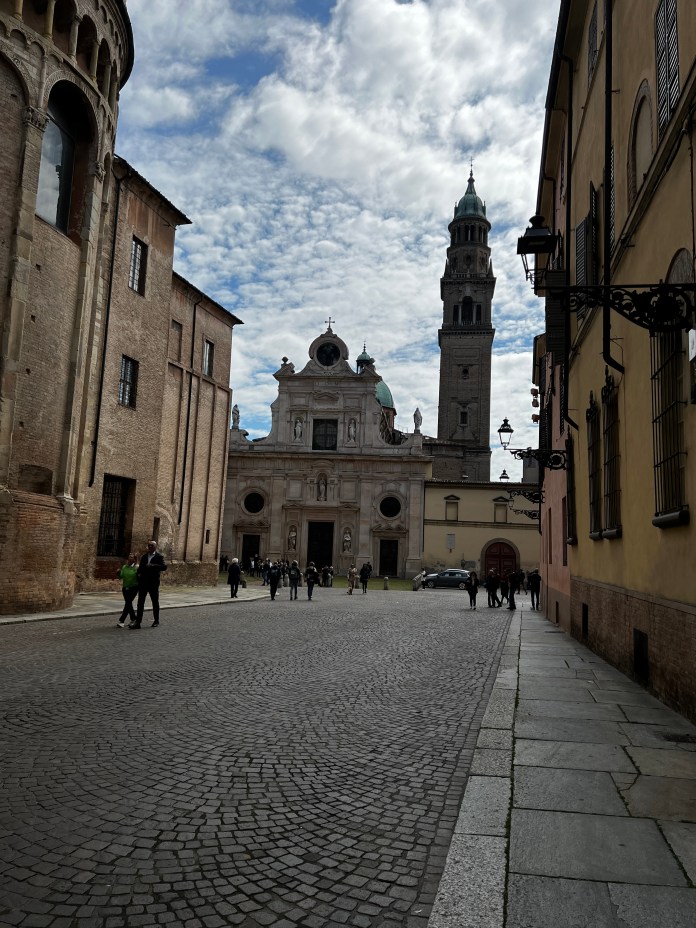
Flags were everywhere because of the holiay.Art insitute.Outside the Duomo.Baptistery.Gay pride was everywhere in Italy. I saw that PACE (pa-chay) flag in every city. Pace means “peace” in Italian.Unlit rotunda.You could pay 2 euros to light up the rotunda.Bill lit a candle for his late dad, who was a Catholic.
A busker entertained us with Bach. He made me cry.
The monastery is located very close by the Parma Duomo. We had to wear FFP2 masks to see the library.
Nobody checked our green pass.
After more walking around, and more photos taken, we found our way to a quiet little plaza where we had lunch at a restaurant called Osteria del Teatro. This was a cute and popular place where excellent blues music paired with really nice local dishes and wines. Old vinyl records were used as placemats!
The salami was so fresh!I had a beef filet with bernaise sauce and potatoes.Bill had suckling pig.Bill had a crumble with custard.Cheesecake with chhocolate mousse!
Below are some more photos from our day in Parma. Some decorations are in honor of the holiday.
Again– PACE flag by a church.Horse meat!
By late afternoon, we were ready to go back to the B&B and drink more wine… which we did.
I loved this white. It was like peaches!More Parma ham…The view from the castle.
After our wine break, we watched old American shows dubbed into Italian… The Dukes of Hazzard, The A Team, and Walker, Texas Ranger! No wonder I saw so many Confederate battle flags in Italy.
Our last full day of our trip was probably our most touristy-vacation-esque of our trip. We went to Salzburg and walked around, taking in the sights. Once again, I regret not buying any art, since we passed a few galleries which were closed by the time we departed in the late afternoon. Salzburg is a beautiful city, with lots going on, and a lot of photogenic scenery. We mainly walked around, but we also visited St. Peter’s Abbey and, after Bill lit a candle for his late father, who was a Catholic, we had a very expensive but delicious lunch at Peter, one of the restaurants in St. Peter Stiftskulinarium, which was founded in 803 AD. We didn’t know anything about the restaurant when we visited, but it turned out to be a very successful stop.
Below are some photos from our walk around the city before lunch…
We decided to skip the Salzburger Dom, since we’d seen it before.
Last time we were in Salzburg, there were many Friesian horses… Not this time.
This guy was walking on air.
Buskers are pretty common near the Dom. Last time, we ran into a choir of Russian soldiers who made me cry.
St. Peter’s Abbey…
It’s been a year since Bill lost his father. He was not able to attend the funeral.
Peter is right next to the Abbey. They were decorating it for Christmas and, I have to admit, I was drawn in by how beautiful the restaurant was looking with the Christmas lights, trees, and ornaments. It turned out they have good food, too… for a price. But we didn’t mind, as it was a really nice meal and the only “fancy” one we had on our trip. In fact, we didn’t spend much money on food at all, most days. I wish it showed on my body, but I guess I’d have to give up booze for that to happen…
The outdoor area of the restaurant.
The entrance.
Handy menu.
Bill wanted to order a Chateauneuf-du-Pape, but they were out of what he wanted.
This was a nice substitute, at 120 euros! That was 20 euros more than the other bottle that they didn’t have.
I had a small pickled salmon starter with quinoa and radishes.
Bill had burrata with sweet cherry tomatoes.
For my main course, I had roasted duck breast with orange sauce and potatoes.
Bill had venison with potato dumplings and pureed celery.
And dessert for me was a dark chocolate cream.
Bill had a lemon meringue tart.
Another shot of the dessert.
Peter gets mixed reviews. Some people think it’s an overpriced tourist trap. Personally, I enjoyed it, except for the pop music on the sound system, which didn’t seem to go with the food. Also, we were surprised when we came into the restaurant and the hostess told us we didn’t have to wear masks if we were vaccinated. We weren’t upset about it… just surprised. The restaurant was pretty busy and was doing a brisk business. I had originally wanted to get steak there, but they sold it by the gram and it started at 350 grams, which was way too much food for me. Maybe if Bill and I could have split it. We were happy with what we had, though. The duck was delicious, and Bill always enjoys venison whenever he can get it, since I don’t usually eat it myself. Our bill was about 250 euros, but it was money well spent.
After lunch, we walked around the cemetery, taking notice of how beautiful and ornate the graves were. Some of them had actual well-tended gardens on them. I haven’t even mentioned Mozart, who is everywhere in Salzburg, since it’s where he was born.
And as we came out of the cemetery, we found the Wasserrad, a long running source of power…
It was at about this time that we decided to pick up a few souvenirs, mostly for Bill’s co-workers, who bring us stuff on their travels. I also got a new beer stein for my collection. I now have two from Germany, two from Austria, and one from Switzerland. I tried to talk Bill into getting a hat, like the ones we saw in The Sound of Music. He turned me down.
Bill didn’t want one of those hats.
I don’t think I’ve ever actually seen anyone playing one of these life size chess games.
We have one in our Dorfplatz, but I’ve never seen anyone using it.
This young lady, Valentina Marshinoskaya, was playing lovely music, so we bought one of her CDs.
And finally, we decided to visit the Stieglbrau, a restaurant affiliated with the brewery. It also has a Biergarten/Winter solarium for those of us who just come to drink, as Bill and I did… I think it was worth visiting for the views alone! Last time we were in Salzburg, back in May 2012, the restaurant wasn’t open. I don’t remember why.
I enjoyed this beer… Bill had an IPA, and I had a Hefeweizen… and a Naturtueb.
A Stolperstein (stumbling stone) commemorating a Holocaust victim.
Salzburg is so pretty!
Bill ducked in to a little gourmet shop to get some Stiegl beer, some deer and antelope sausage, and a new beer mug for me. I was really feeling the urge to shop, since so many places in Croatia and Slovenia were closed.
The sun was sinking as we went back to the garage to get the car. Austrians are so civilized, they had a very clean WC there, which I needed to visit. Unfortunately, I almost walked into the men’s room… a couple of locals laughed about that! Then, on the very short drive back to Ray’s house, we were stopped at a light, and some mean spirited jackass on a bike and carrying a skateboard knocked on the window. When I looked up, he shot me the middle finger while wearing a most hateful expression on his face, which is illegal in Germany and, my German friend Susanne says, is also illegal in Austria. Needless to say, I quickly fired back, and hope he fell off his bike and neutered himself. I don’t know why he flipped us– or really, me– off. I had nothing to do with any traffic offenses, since I was sitting in the passenger seat, minding my own business. Asshole.
We decided to relax on our last night on vacation, though if I’m honest, I was really ready to go home. After awhile, it gets tiresome living out of a bag. I also really missed the dogs. So, although we had a good day in Salzburg and could have seen a lot more, I was ready to go back to normal living.
Stay tuned for the last post in this series, part fourteen.
Bill and I never made it out yesterday, mainly because the weather is starting to change. It was rainy off and on yesterday, and we just didn’t feel like going out anywhere. So we stayed home, ate takeout, listened to music, and enjoyed some libations on the patio.
Today, we had nicer weather. Bill wanted to go out. I was still kind of inclined to stay in, because I have become a slovenly old battleaxe over the course of the past 18 months or so. However, it’s really not good for my mental health to stay home, nor is it particularly good for my physical health, since I tend to sit around and drink. So I let myself be convinced to go out. We could have gone to the Frankfurt Dippemess, which is going on until next weekend. But there’s no parking at the fairgrounds, and Bill and I don’t ride the rides or anything. I mean, I probably would, but Bill doesn’t like to.
I had mentioned yesterday that I wanted to go inside the Mainzer Dom (Mainz Cathedral). Somehow, despite living in Wiesbaden for almost three years, we never bothered to go inside the cathedral, which is massive and gorgeous. So today, we decided we’d go. Below are some photos from today’s visit. The Mainz Cathedral dates from 975, and has been renovated many times during its long history. I was very moved by how massive and beautiful the cathedral is. There are so many gothic accents and beautiful windows. There are also new stained glass windows, which were made by the glass artist Johannes Schreiter and installed in 2004.
The Dom costs nothing to visit, although donations are gratefully accepted. It’s open to visitors outside of service times Monday through Saturday from 11:00am until 4:00pm. On Sundays, it’s open to visitors from 1:00pm until 4:00pm (although Google says it’s open until 6:30pm).
As is his habit, Bill bought a candle for his father, who died in November 2020. He wasn’t able to go to his dad’s funeral, thanks to COVID-19. So, now when we enter cathedrals, Bill usually lights a candle and says a prayer. I have been to a lot of cathedrals since we’ve been over here. I think Mainz might have one of the most architecturally impressive ones I’ve seen yet. It’s really beautiful. I would love to hear the organ.
After we took a quick tour of the Mainzer Dom, we walked around the area so I could get more photos. I actually have a bunch of pictures from around Mainz, but the flower gardens are always changing. Plus, Mainz is just one of those cities that seems to pulsate with life and energy.
My German friend reminds me the sculpture is the Heunensäule.
We were feeling a little hungry and needed to visit the restroom, so we went searching for food. I found Caleo on my trusty iPhone, indicating the restaurant was open all day with no pause. So we headed for there, first taking a detour to the river, so I could get a few photos.
This isn’t too far from the “beach” on the Mainz side of the Rhein.
Someone left a book leaned against a building.
We were kind of impressed by Caleo, which boasts an innovative menu with some interesting menu choices. There were some exotic items on the menu. Bill ended up ordering a crocodile steak, for instance. I went with a Spicy Wagyu Burger, which came with cheddar cheese, tomatoes, jalapeno peppers, onions, chili mayo, and lettuce. I have a feeling Bill would have liked the spicy burger more than I did. But it was definitely better than last week’s burger in Wiesbaden.
We started with chocolate stout beers from Yorkshire, England. They were definitely chocolatey, and a little bit sweet. But they were a nice change from the usual.
The door to neighboring Heiliggeist, where Bill and I ate a few weeks ago.
Our beer coasters.
We have some of this beer at home.
Fresh bread with krauterbutter.
Bill loved his crocodile steak, which came with sesame encrusted potato croquettes.
My burger with an optional side of fries. The fries were fabulous. They reminded me of Belgian frites. The burger was good, but served rarer than I’m used to.
Another shot out front.
We sat on the balcony, under the awning. Glad it didn’t fall on us.
Service at Caleo was professional and friendly. Our server mostly spoke German to us, but did know English pretty well. I was flattered that she didn’t immediately peg us for Yanks. I guess all of these years in Europe have rubbed off on us. I was impressed by the food and the menu, which definitely offers some exciting choices. They had bison, for instance, and their vegetarian burger has a bun made from jackfruit. They also had a burger called “zebra”, made of zebra meat. I wasn’t about to try it. I think zebras are gorgeous. Sigh… I probably should be a vegetarian.
The weather today has been fabulous— sunny, and about 75 degrees during the afternoon. It was nice to get outside and walk around. And I was delighted to finally visit the Mainzer Dom, which is as stunning on the inside as it is on the outside. It made for a nice Sunday afternoon activity. I’m glad we went. Hope we continue to have such great weather.
Last month, when Bill and I went to Zürich, we visited the Fraumünster church. That church is famous for having beautiful stained glass windows created by the Jewish French-Russian artist, Marc Chagall. I wasn’t familiar with Marc Chagall before we saw his windows in Switzerland last month. After I posted some photos on social media, a German friend told me that I could also see Chagall’s work in Mainz, at The Collegiate Church of St. Stephan. We live close to Mainz, but before yesterday, we hadn’t been there in a long time. Not only did COVID-19 keep us away, but there was also some construction being done on the bridge over the Rhein River which made crossing over there problematic. The bridge connects our home state of Hesse with Rheinland-Pfalz. I had actually forgotten that going to Mainz means leaving the state!
I think the last time Bill and I went to Mainz, it was to see my old friend, C.W., who is an American learning about German wines. I worked with C.W. in Colonial Williamsburg, back in the late 1990s. C.W. moved to Washington, DC and worked in a succession of fancy restaurants. He later decided he wanted to work in the wine industry, so he’s been getting educated. In the fall of 2019, he came to Germany to work at a winery as part of his education. He came back in the spring of 2020, just before COVID shut everything down. We weren’t able to see him on that visit, and we didn’t visit Mainz again last year or this year. That means that yesterday’s visit occurred almost two years after our last one! We had a good time yesterday. We’ll have to visit Mainz more often, now that we’re vaccinated. It really is a neat town with much to discover.
After looking at the location of St. Stephan’s Church, Bill decided he’d like to go out to eat. He found Heiliggeist Restaurant (Holy Spirit) on Open Table and decided that its status as the oldest citizen hospital in Germany fit nicely with our church theme. He made reservations for 3:30pm because, apparently, there weren’t any earlier ones available. I’m not sure why that is, since there were plenty of tables available when we were there yesterday. But anyway, the church was open for visitation from 12pm until 4pm, so the late lunch/early dinner time slot worked out fine. We took my neglected Mini Cooper, since the weather was fine and I could put the top down. I had forgotten how different the atmosphere is in Mainz, compared to Wiesbaden. It’s a refreshing change of pace.
After parking at the theater garage, we trudged uphill to the church. It was about a ten minute walk from where we parked. I hadn’t realized the church wasn’t in the old part of the city and was kind of unimpressed with the neighborhood that surrounded it. From the outside, St. Stephan looks like so many of the other churches in Germany. That’s not to say it isn’t a beautiful or impressive structure. It is a very lovely church, especially compared to many American churches. I’m just saying that compared to a lot of churches in Europe, from the outside, it didn’t look any more or less spectacular.
On the way out of Mainz-Kastel, there are many impressive murals on buildings. This is one.Look carefully, and you can see a fabulous slide. I love that Germany has so many fun playgrounds for kids. Makes me wish I could have been one here.A cryptic line on a building. Bill thought it was referring to The Matrix. My German friend says it’s about this… St. Stephan as we walked near.I had no idea what I was about to see.The front door. I donned a mask and disinfected my hands…
But then we went inside, and my mind immediately changed about the beauty of St. Stephan… I was overcome by the cool, soothing, incredibly beautiful, and peaceful mood cast by the extraordinary blue windows… The entire inside of the church is bathed in a blue glow made by Chagall’s windows, the first of which was installed in 1978. Chagall was 91 years old in 1978, and he lived until 1985, which only goes to show you that when it comes to great accomplishments, age really is just a number.
As I took in the azure splendor of the great artist’s work, I realized that I much preferred Chagall’s windows in Mainz to Chagall’s windows in Switzerland. A bonus is, it costs nothing to visit this church. In Zürich, we had to pay five Swiss Francs each admission to see a few of Chagall’s windows.
Of course, I might have loved these windows more because my favorite color is blue. I also just loved the way they all worked in concert to give the church an overall mood. I donated some change to the church while Bill lit a candle for his father, then he purchased a CD of the organ and some postcards at the gift shop. He says he’s going to try his hand at picture framing. Since my dad made his post Air Force living framing pictures, it’s a shame he’s no longer around to show Bill the ropes. The CD is, of course, for me. I am more moved by music than visual artistic endeavors. My mom was a church organist for over 50 years, so I probably have more of an appreciation for organ music than a lot of people do. However, as I listen to the music now as I compose this post, it occurs to me that if I could have been listening to it while touring the church, I probably would have been overwhelmed. I definitely am glad we took the time to visit St. Stephan and see these gorgeous windows! The church itself has an incredibly long history, having been established in 990. It is the only church in Germany that has windows by Marc Chagall, and I must say, the windows dazzled me! What an inspiration!
Exiting through the peaceful courtyard…They are making a habitat for bees…We passed this peaceful square on our way to the old town, where Heiliggeist awaited.
It took about ten or fifteen minutes to walk from the church to the old town. I needed a restroom, but we had about an hour before our reservation at Heiliggeist, so Bill and I decided to stop at a cafe. I took some more photos on the way down. Mainz really is a nice town, and there’s still a lot we haven’t seen or done there.
I still have yet to visit the inside of the Dom.The cafe filled up right after I took this photo.Cafe Dinges had some beautiful cakes on display…And lots of people stopped in for coffee and cake. We were there mainly so I could pee. We did have a round of beverages there, though. The staff also kindly gave a homeless looking man some water. We’ll have to go back and have dessert sometime.
At last, it was time to head to the restaurant. Thanks to COVID, everybody was sitting outside. I was a little disappointed, because I wanted to see the interior. I did get a few shots of the inside of the restaurant, but I would have preferred to eat indoors. Actually, I prefer eating indoors most of the time, as the seating is usually more comfortable; there’s no smoking; and we don’t have to contend with insects or other creatures. But the weather was good yesterday and it wasn’t too hot outside, so aside from uncomfortable chairs, I can’t complain too much.
Heiliggeist serves “fusion” food– Asian inspired and “new German”. They have a full bar, and a summer “carte”, as well as menu staples. Bill had the “Lachs Bowl”, which was very “Asian inspired.” I had the cold roast beef, which was more of a European thing. We both really enjoyed the food and the service. Prices are reasonable. Both my dish and Bill’s were priced below twenty euros each.
The outside of the restaurant. It used to be a hospital. As we approached, a grandfather was chasing his little toddler granddaughter back and forth. It was a charming scene.Bill checks the menu.He ordered some local wine…Bill ordered the Asian inspired “Lachs Bowl”, which was salmon with rice, edamame, and vegetables.I had the cold roast beef from Argentina. It came with roasted potatoes and a horseradish sauce.The inside of Heiliggeist.I had cheesecake for dessert. It was warm, gooey, and delicious, and came with raspberry ice cream.Bill had the brownie, which was delightful because it wasn’t a lava cake. It came with vanilla ice cream and walnuts.They had these outdoor “booths”. I suppose they could be covered in bad weather.On the way to the restroom, I was amused by the rabbit lamp.This is a private party room. There was a party going on.A couple of shots of the garden…I didn’t like the chairs at all, though.
After about two hours at Heiliggeist, we headed back to the parking garage, which was about fifteen minutes away by foot. I took a few more images. All told, we walked about 2.5 miles. At least, that’s what my iPhone tells me.
A couple of views of the Dom…We walked down a side street because I wanted to check out a couple of other restaurants nearby.Another shot of Heiliggeist.Large tour groups are back in Mainz. Just before I took this shot, some idiot ran into the street from his car, stopped at a light. Why? Because he dropped his cigarettes out the window. I think he then challenged another car to a race. Idiot running in the street.
We got back to the house at about 6:00pm. Arran and Noyzi were very happy to see us and gave us joyful greetings. We went to bed feeling pleasantly tired by the day’s activities. I think we need to spend more time in Mainz. It really is a nice town, and it’s so different than Wiesbaden is on so many levels. I feel fortunate that we have this chance to live in another part of Germany besides Stuttgart, and experience how different the regions are. I continue to be grateful that we can live here and see so much.
And here’s what St. Stephan’s organ sounds like… Heavenly! Wish I could have heard this majestic organ as we were gazing at the beautiful windows.




You must be logged in to post a comment.